
By Elizabeth Kusmider, CFP®
Estate planning and life insurance estate planning business owners rely on are often handled by different professionals in separate conversations. That separation can create real problems — because the two are deeply connected, especially for business owners and high-income executives whose estates involve illiquid assets, complex ownership structures, and significant family dynamics.
I am Elizabeth Kusmider, CFP®. I work alongside estate attorneys and wealth managers to make sure the insurance piece of a client's estate plan is designed to support the broader strategy — not just to exist alongside it. Here is how life insurance fits into estate planning for business owners and executives, and why the design details matter.
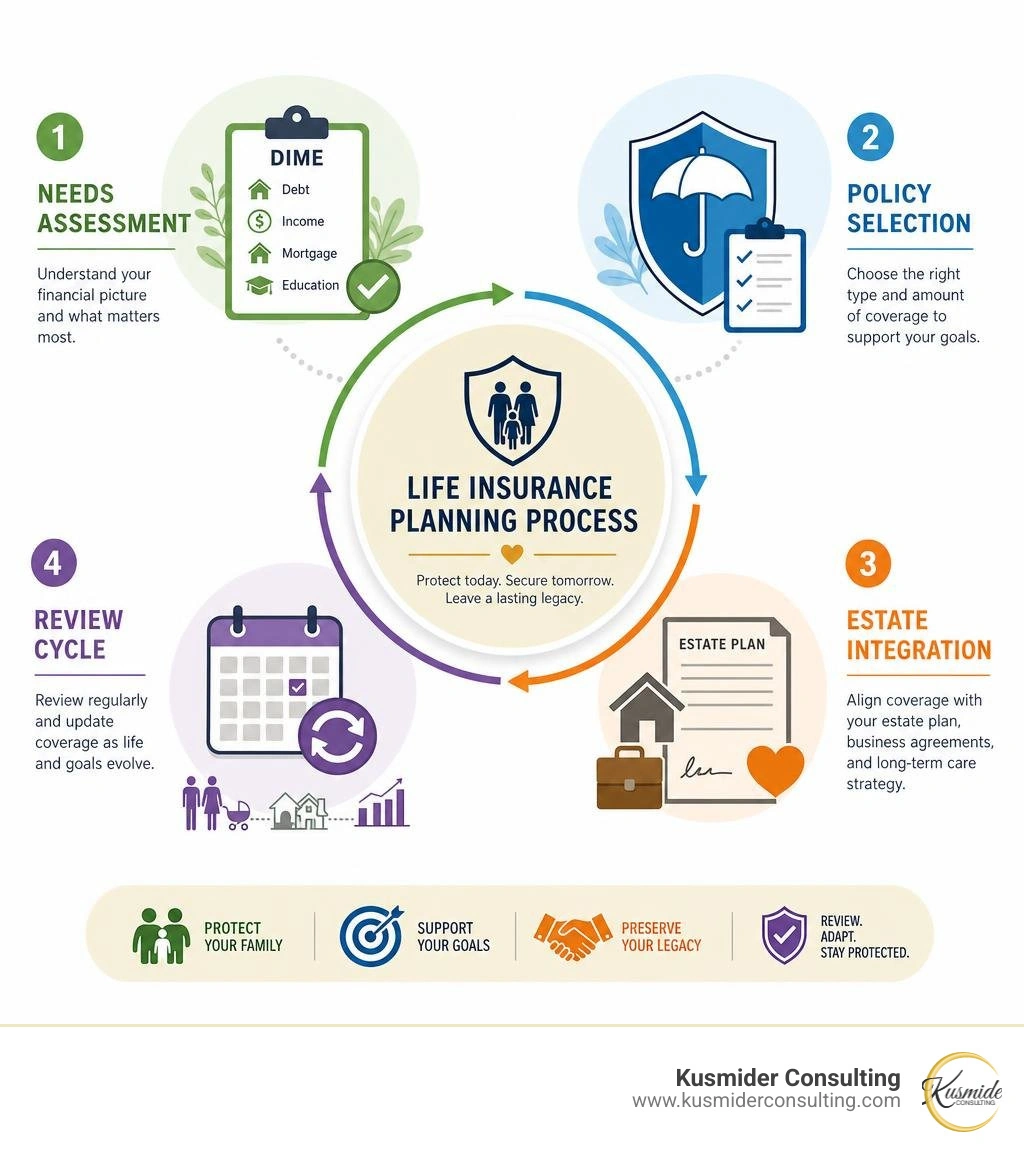
Federal estate taxes are due nine months after death. State estate taxes — in states like Illinois — may have different timelines and different exemption thresholds. The bill is payable in cash.
For business owners, that creates a specific problem: the estate may be wealthy on paper — a business worth several million dollars, real estate, equipment, retirement accounts — but not liquid. The family may not be able to write a check for the estate tax without selling something. And selling a business interest under time pressure, into an estate sale environment, is rarely a favorable transaction.
Life insurance is the cleanest solution to this problem. A permanent policy provides a death benefit at exactly the moment it is needed — at death — and that benefit can be structured to arrive outside the taxable estate through an irrevocable life insurance trust. To understand how these pieces fit together, read our overview on Is Your Future Protected: Planning for a Now and Later.
An ILIT is a trust that owns the life insurance policy, rather than the insured owning it personally. Because the insured does not own the policy, the death benefit does not count as part of their taxable estate. The trust receives the proceeds and distributes them according to its terms — which can be written to pay estate taxes, provide for heirs, or fund a buy-sell agreement.
ILITs require careful setup and ongoing administration. The trust must be funded properly each year through annual gifts, and the insured cannot retain certain rights over the policy or the trust. I work in coordination with estate attorneys to make sure the trust structure and the policy are set up correctly from the beginning. For more details on permanent options, you can review our guide on Permanent Life Insurance for High Income Earners.
One of the most common estate planning challenges for family business owners is how to treat children fairly when one child is involved in the business and others are not.
Leaving the business equally to all children typically creates conflict — the child running the business does not want outside ownership diluting their control, and the children not involved in the business may not see the value of illiquid equity they cannot access. Leaving the business only to the child running it can feel unfair to the others.
Life insurance provides the tool to equalize without disrupting the business. The business transfers to the active child, and the other children receive an equivalent benefit through the insurance proceeds. The estate is divided fairly, the business continuity is preserved, and the family dynamic is protected. For more on this, read our guide on Family Owned Business Insurance.
For business owners without a family successor — planning to sell to a key employee or management team — life insurance can fund the transition. A properly structured policy on the owner can provide the capital the successor needs to purchase the business, eliminating the need for bank financing that may not be available or may come with conditions that complicate the transition.
This is particularly relevant for professional service businesses — law firms, accounting practices, medical practices — where the value is concentrated in relationships and expertise rather than hard assets. Financing a transition of these businesses through traditional debt can be challenging; life insurance provides a more reliable and flexible alternative. Learn more about these strategies in our guide on What is Key Person Insurance.
Estate planning applications for life insurance almost always require permanent coverage. The reason is simple: estate planning needs do not expire. You do not know when you will die, and the estate tax liability — or the inheritance equalization need, or the succession funding need — exists regardless of timing.
Term coverage expires and becomes unavailable if you develop a serious health condition before the need is resolved. Permanent coverage guarantees the death benefit will be there, which is the only promise that is actually useful in an estate planning context.
The most effective estate planning outcomes I have seen come from coordinated teams: an estate attorney handling the legal documents, a wealth manager or CPA handling the tax strategy and asset management, and an insurance specialist making sure the coverage design supports what the other pieces require.
My role in that team is to design the insurance so it actually does what the plan needs it to do. That means making sure the policy type, death benefit amount, ownership structure, and beneficiary designations are all aligned with the estate documents and the client's goals.
If you have an estate plan in place and you are not certain whether the insurance component is designed to support it correctly, that is worth reviewing. A gap between the legal plan and the insurance behind it can make the whole strategy fall short. To help identify potential gaps, we recommend taking our Life Insurance Stress Test.
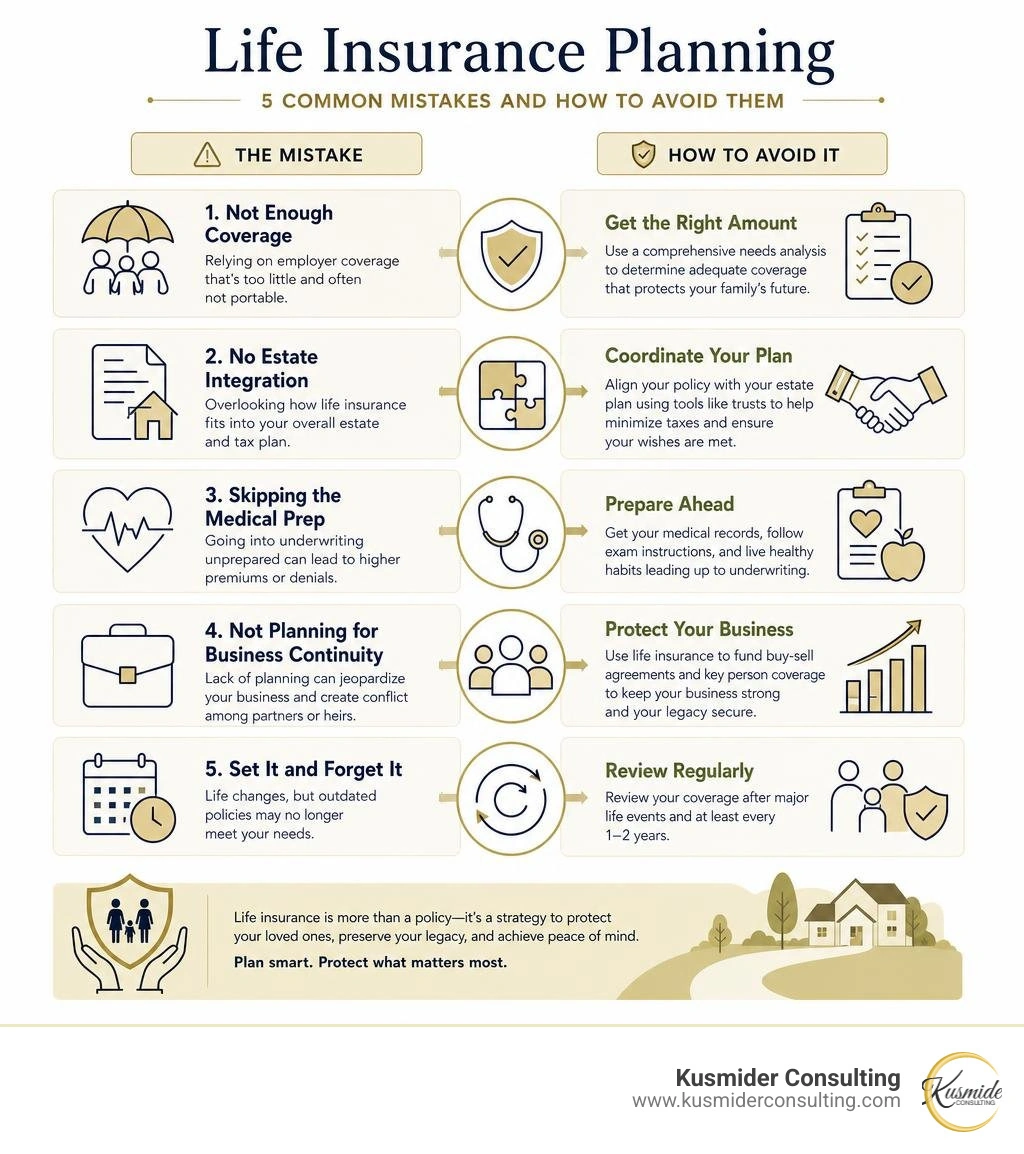
Elizabeth works closely with wealth managers and estate attorneys to bring insurance planning into broader client conversations. We are here to help make that process simple, not stressful. To schedule a planning session or discuss a client situation, reach out to Elizabeth Kusmider, CFP® at info@kusmiderconsulting.com.
As a full-service, independent brokerage based in Houston, Texas and available throughout the U.S., we specialize in aligning insurance solutions with broader financial strategies. We provide expert guidance, unbiased product recommendations, and ongoing policy oversight to ensure your coverage evolves with your needs.
Whether you're reviewing your own protection or advising clients, we’re committed to helping you make informed, confident decisions.

Elizabeth founded Kusmider Consulting with a simple goal: help people make informed insurance decisions without confusion or pressure.
As a Certified Financial Planner™, she brings a planning background to insurance work, focusing on how coverage fits into the broader financial picture, not just policy features.
If you’d like to discuss how a topic applies to your personal or professional situation, we’re happy to talk.
Schedule a Planning callLife insurance planning for people who want clarity, structure, and long-term oversight.

Securities offered through Simplicity Investments, Member FINRA/SIPC; 475 Springfield Ave, Summit, NJ 07901 (303) 797-9080. Kusmider Consulting is not affiliated with Simplicity Investments.
The Leaders Group, Inc. Customer Relationship Policy
Broker Check by FINRA .