What if the right life insurance decision is not the cheapest long-term option, but the most flexible short-term one?
An annually renewable term policy is a type of term life insurance that provides coverage for one year at a time, with the option to renew each year without taking a new medical exam.
Here is a quick overview of how it works:
The appeal is simple. You get immediate, affordable coverage with no long-term commitment. But the cost grows every year, which makes it less practical the longer you hold it.
Most people exploring this type of policy are dealing with a specific, time-limited need. Maybe it is a short-term loan, a gap between jobs, or a window while waiting for better health classifications. This guide will help you decide if an annually renewable term policy fits your situation or if another option makes more sense.
Business owners often use this policy to protect a temporary obligation. High-income professionals may use it as bridge coverage during a career transition or while coordinating a broader insurance strategy. Family history can also shape the conversation, especially when someone wants coverage in place now while evaluating longer-term planning options.
I am Elizabeth Kusmider, CFP®, and through my work at Kusmider Consulting I help individuals, families, business owners, and advisors evaluate coverage options like the annually renewable term policy as part of a broader financial strategy. Our approach is centered on clarity without sales pressure, tailored coverage, and long-term oversight.
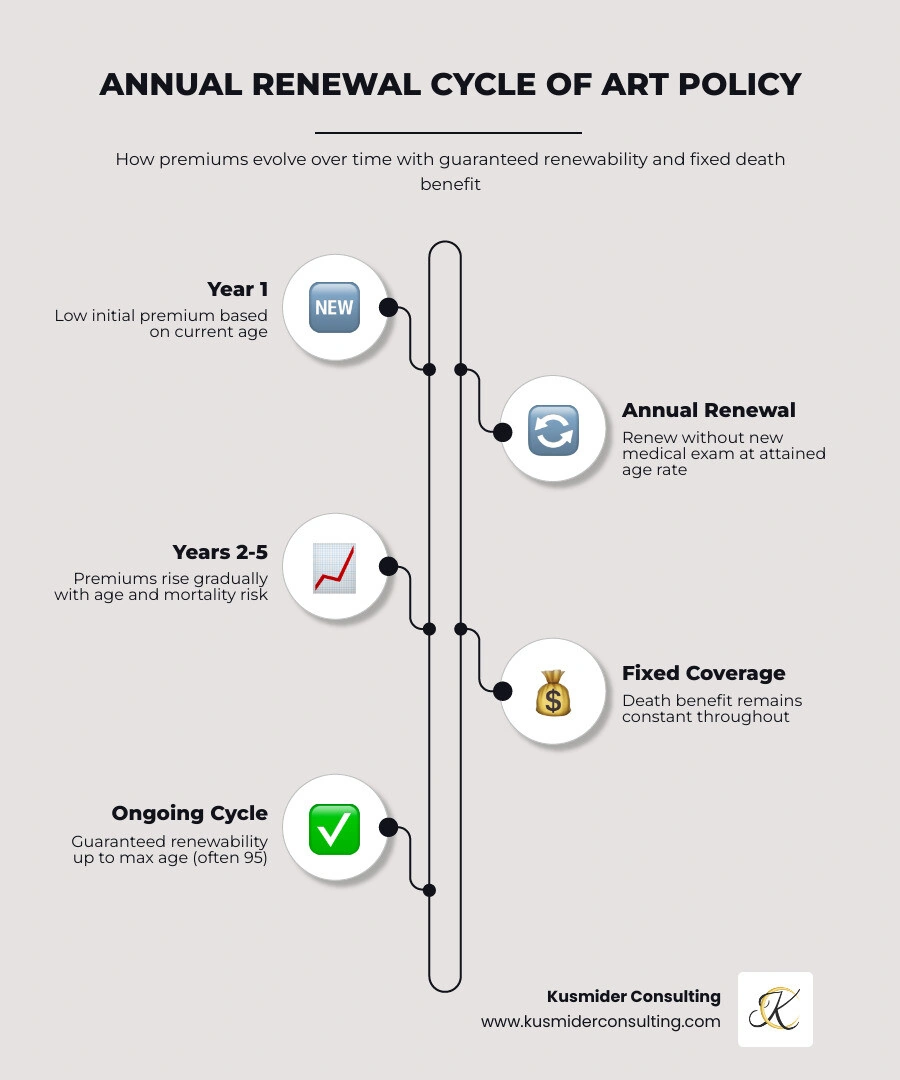
When we look at the core of an annually renewable term policy, we are looking at what many in the industry call "pure" insurance. Unlike level term policies that lock in a rate for 10, 20, or 30 years, this policy is a one-year contract. Every time the calendar flips, the contract effectively resets.
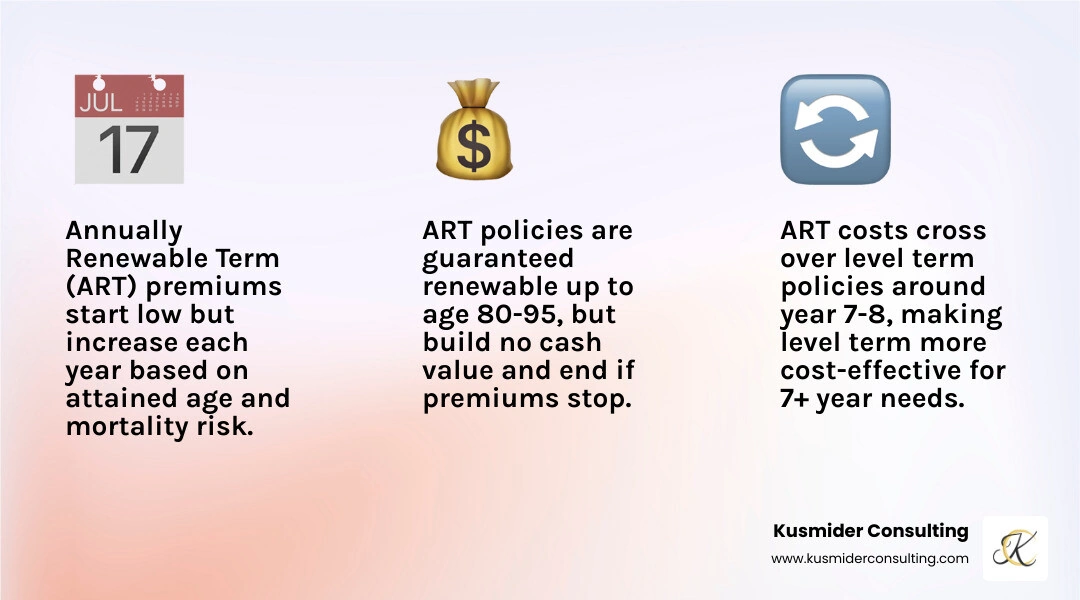
The pricing is based on your attained age. This means the insurance company looks at the statistical likelihood of a person your age passing away within that specific year. This is known as mortality risk. Because that risk naturally increases as we get older, your premium increases right along with it.
The most critical feature of this structure is guaranteed renewability. Even if you develop a health condition during the year, the insurance company generally cannot refuse to renew your policy or charge you more than the pre-set rate for your age group under the policy terms. You are essentially locking in your insurability rather than locking in a price. For a broader overview of the concept, you can explore Annual Renewable Term (ART) Insurance: What It Is, How It Works.
If you look at your policy documents, you will usually see two sets of numbers: the scheduled premiums and the guaranteed maximums. The scheduled premium is what the company expects to charge you. The guaranteed maximum is the absolute ceiling they can charge under the contract.
When comparing an annually renewable term policy to level term options, we have to look at the cumulative cost. For example, a healthy 30-year-old male might pay only $300 in Year 1 for $1M in coverage. A 20-year level policy might start at $413. Initially, the ART policy looks like a bargain. However, by Year 20, the cumulative premiums for the ART policy may exceed the level term option. By Year 30, that gap can widen even further.
The decision often comes down to the time value of money. If your goal is truly short-term protection, paying less now may free up cash flow for other planning priorities. But if you expect to keep coverage for many years, locking in a longer term rate is often more efficient.
In our practice, we find that the annually renewable term policy is rarely a forever solution, but it can be an excellent bridge tool.
Business owners may need temporary coverage tied to a short-term debt, buy-sell funding timeline, or contract obligation. High-income professionals may use it to cover a transition period until a new employer benefit package begins or a broader personal plan is finalized.
Another common use case is a smoking cessation bridge. Many insurers require a period of tobacco-free time before offering non-smoker pricing. If someone recently quit, it may make sense to use an annually renewable term policy briefly and then reapply for a longer-term policy once a better health class may be available. This type of timing decision is part of how we approach Is Your Future Protected? Planning for a Now and Later.
For advisors, this can be a helpful conversation starter with clients: "You may not need a permanent answer today, but you may need a smart bridge." Your role is to open the door. We can help evaluate the policy details and how the short-term coverage fits into the larger plan.
Success in insurance planning is often about timing. The more important question is not just whether a policy is renewable, but whether it fits your planning window.
We focus heavily on the planning window between ages 35 to 60. During this period, health is often still strong enough to secure favorable options, while your financial picture is becoming clearer. A healthy 50-year-old usually has meaningfully more flexibility than a 64-year-old, both in underwriting and in the range of policy structures worth considering.
A helpful guideline is the Seven Year Rule. Generally, if you expect to keep coverage for seven years or longer, a 10-year level term policy is often more cost-effective than an annually renewable term policy. If your goal is reaching financial independence in a very short timeframe, such as three or four years, the ART policy can be the better fit. For a general consumer overview of renewable term insurance, see Renewable Term life Insurance | Corebridge Direct.
One of the most overlooked features of a high-quality annually renewable term policy is the conversion rider. This allows you to trade your term policy for Modern Permanent Insurance, such as whole life or universal life, without a new medical exam.
This can be an important safety net. If your health changes and new coverage becomes difficult or expensive to obtain, a conversion feature may allow you to move into permanent coverage based on your original insurability. We often discuss these transitions when helping clients explore how Long-Term Care Plans with Guarantees? Yes, It's Possible.
While these policies are renewable, they are not unlimited. Most companies set a maximum renewal age, typically between 80 and 95. In some states, renewal limits may be more restrictive.
As you approach those age limits, the premiums typically become much more expensive. It is also important to remember that an annually renewable term policy does not build cash value. It is a pure death benefit solution. If you outlive the renewal age or stop paying premiums, the coverage ends. For a general discussion of renewal limits, you can review Annual Renewable Term Life Insurance | LifeInsurance.org.
For our high-income clients and business owners, insurance is one part of a broader Estate & Legacy plan. While an annually renewable term policy can address short-term risk, long-term planning often includes decisions around Long-Term Care, liquidity, and permanent protection.
When we discuss Long-Term Care, we frame it as a financial planning decision, not a health one. Medicaid spend-down is not a plan, but a last resort. This approach typically requires exhausting assets, making early planning a more effective way to maintain control over care options.
This is why the planning window matters so much. A healthy 50-year-old may have access to more flexible and efficient choices than a 64-year-old who waits. That is where options such as Standalone LTC, Hybrid plans, or Life with LTC rider can become part of a thoughtful strategy. Whether you need short-term bridge coverage or a more permanent estate solution, our team at Kusmider Consulting provides clarity without sales pressure. You can see the full scope of how we help on our Our Services page.
Long-term care is not a distant concern; it is a present planning opportunity. The families who handle it well are the ones who started the conversation early, explored their options with a clear head, and made a decision that fits their life. We are here to help make that process simple, not stressful.
At Kusmider Consulting, we take a planning-first approach, providing clear, objective guidance without product-pushing sales tactics. We partner directly with your existing wealth managers, CPA, and estate attorneys to ensure your insurance strategy perfectly aligns with your broader tax and estate goals. For advisors looking to bring sophisticated insurance planning to their clients, we make collaboration seamless. You can learn more about how we partner on our page For Advisors or review our full suite of planning capabilities under Our Services.
Elizabeth works closely with wealth managers and estate attorneys to bring insurance planning into broader client conversations. We are here to help make that process simple, not stressful. To schedule a planning session or discuss a client situation, reach out to Elizabeth Kusmider, CFP® at info@kusmiderconsulting.com.
As a full-service, independent brokerage based in Houston, Texas and available throughout the U.S., we specialize in aligning insurance solutions with broader financial strategies. We provide expert guidance, unbiased product recommendations, and ongoing policy oversight to ensure your coverage evolves with your needs.
Whether you're reviewing your own protection or advising clients, we’re committed to helping you make informed, confident decisions.

Elizabeth founded Kusmider Consulting with a simple goal: help people make informed insurance decisions without confusion or pressure.
As a Certified Financial Planner™, she brings a planning background to insurance work, focusing on how coverage fits into the broader financial picture, not just policy features.
If you’d like to discuss how a topic applies to your personal or professional situation, we’re happy to talk.
Schedule a Planning callLife insurance planning for people who want clarity, structure, and long-term oversight.

Securities offered through Simplicity Investments, Member FINRA/SIPC; 475 Springfield Ave, Summit, NJ 07901 (303) 797-9080. Kusmider Consulting is not affiliated with Simplicity Investments.
The Leaders Group, Inc. Customer Relationship Policy
Broker Check by FINRA .