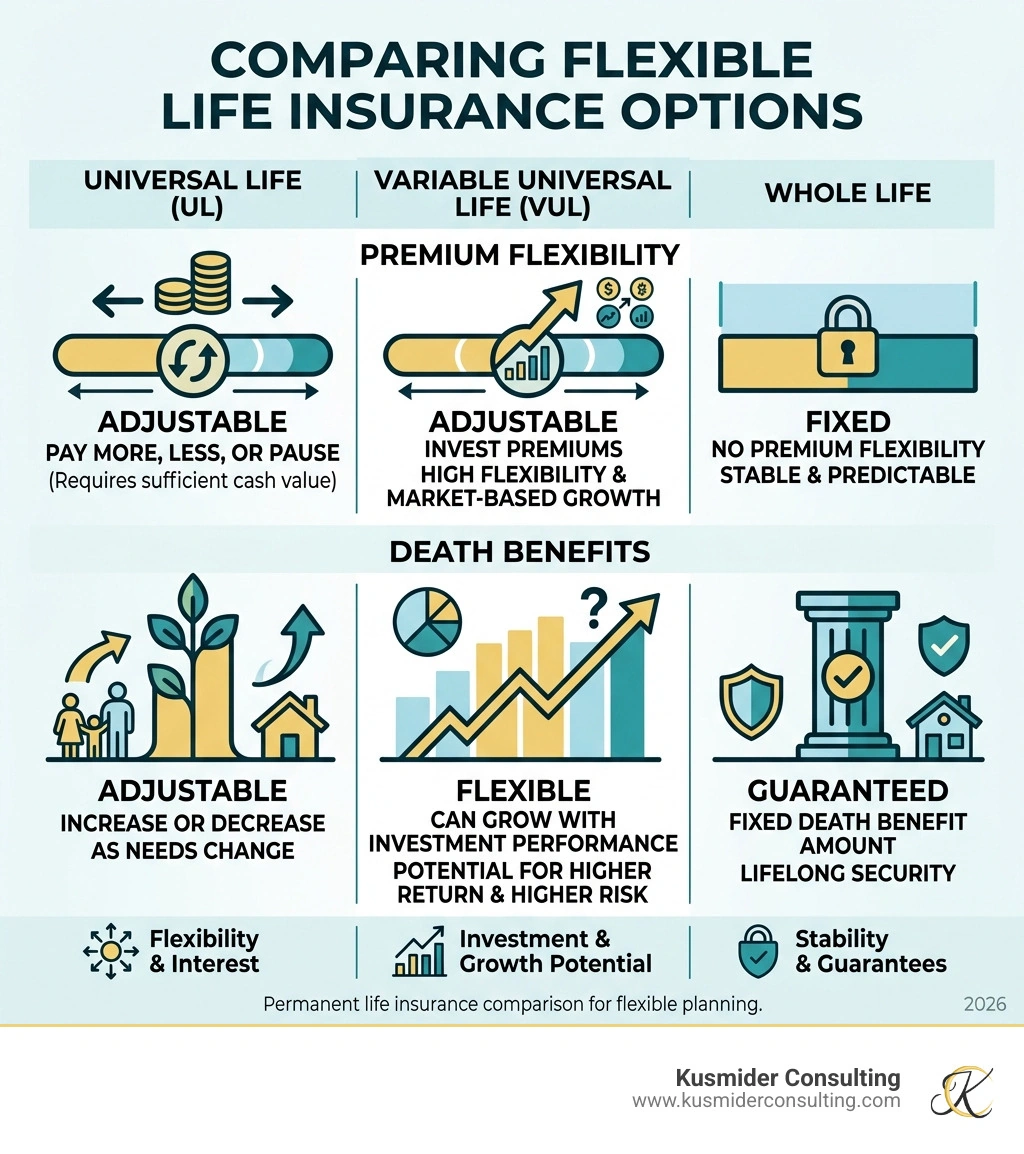
Flexible premium life options give you the ability to adjust your premiums, death benefit, and cash value over time, all within a single permanent policy.
Here are the most common flexible premium life options to consider:
Most people think life insurance is a "set it and forget it" decision. It rarely is. Your income changes. Your family grows. Your business evolves. A policy that could not keep up with those changes was never really built for your life.
Adjustable life insurance, also known as universal life insurance, is a form of permanent coverage that provides lifelong protection as long as premiums are paid. A portion of each premium builds cash value that grows tax-deferred, and the death benefit is generally paid income-tax-free to your beneficiaries.
I'm Elizabeth Kusmider, CFP®, founder of Kusmider Consulting, and I have spent my career helping business owners and high-income individuals evaluate flexible premium life options as part of a broader financial and estate plan. I will walk you through the key options, how they work, and how to choose the right fit for where you are now and where you are headed.

When we discuss permanent insurance, we are looking at a tool designed to last your entire life. However, not all permanent policies are created equal. The rigid structure of a traditional policy may not align with fluctuating cash flow. This is where flexible premium life options shine.
Universal Life (UL) is often the most recognizable form of flexible coverage. It allows you to pay more when you have the surplus and less when you don't, provided you maintain enough cash value to cover the internal costs. Variable Universal Life (VUL) takes this a step further by allowing you to invest that cash value in market-based subaccounts. While it offers higher growth potential, it also involves market-based fluctuations.
In contrast, Whole Life offers fixed premiums and guaranteed death benefits. While it provides stability, it lacks the "dialable" nature of universal products. Term Life is the simplest form, providing coverage for a specific period (like 20 years) with no cash value. While term insurance is affordable, adjustable life policies can cost six to 10 times more because they are designed to last forever and build equity.
Choosing between these requires a look at your current stage and your future goals. Is Your Future Protected? Planning for a Now and Later is a great place to start when weighing these different paths.
The hallmark of these policies is the ability to modify the contract without necessarily starting over with a new application. The three main levers you can pull are:
To make these changes, you typically submit a Policy Service Request Form to your carrier. For those looking for Affordable Life Insurance In Houston, TX, understanding these levers is essential to ensure you aren't paying for more coverage than you currently need. You can also explore how carriers like Guardian structure their adjustable products to see these features in action.
Flexibility is a strategic advantage. For business owners with seasonal or variable income, the ability to skip a payment during a lean month and catch up later is a massive advantage. It allows the policy to stay active during financial shifts that might cause a more rigid policy to lapse.
However, policy performance should be monitored to ensure the coverage remains in force. Every month, the insurer takes out a Cost of Insurance (COI) charge. If premium payments are discontinued and the cash value is insufficient to cover these costs, the policy may lapse. Many modern policies offer a No-Lapse Guarantee, which keeps the coverage in force even if the cash value hits zero, provided a minimum premium threshold is met.
Products like the Prudential FlexGuard® Life IVUL illustrate how companies are adding "buffered" strategies to protect against market losses while still offering growth. This type of Universal Life | Flexible Protection is becoming a staple for those who want the upside of the market without the full downside exposure.
One of the most compelling reasons to use flexible premium life options is the tax treatment. Cash value grows tax-deferred, meaning you don't pay taxes on the interest or gains each year.
You can access this money through policy loans. Generally, policy loans are not considered taxable income as long as the policy remains in force. If you withdraw money up to the amount you've paid in (your "basis"), it is also tax-free. However, if you overfund a policy too aggressively, it may be classified as a Modified Endowment Contract (MEC). This is an IRS designation that changes the tax status of withdrawals to "last-in, first-out," meaning gains are taxed first.
We regularly update our Blog with deeper dives into these tax nuances to help you avoid common pitfalls.

What does flexible life insurance make possible when your goals include legacy, business continuity, and long-term care planning?
For high-income individuals, those with a complex family history, and business owners, insurance is more than a safety net. It is a planning tool that can support liquidity, protection, and legacy goals. The planning window is typically ages 45 to 60. A healthy 50-year-old often has meaningfully more flexibility in product design, underwriting options, and cost than a 64-year-old, whose choices may be narrower and more expensive.
One area where we must be clear and direct: Medicaid spend-down is not a long-term care plan. It is a last resort that requires you to exhaust nearly all your assets, which can limit your options for care. Thoughtful planning is about preserving autonomy, protecting family options, and aligning resources proactively.
We frame Long-Term Care (LTC) as a financial planning decision, not a health one. The question is not simply whether care may be needed someday. The question is how a care event would affect retirement income, portfolio longevity, and the choices available to your family. You have several options:
These living benefits allow the policy to support multiple planning needs during your lifetime. Long-Term Care Plans with Guarantees? Yes, It's Possible to find a solution that offers both protection and a return on your premiums.
For business owners, flexible premium policies can support several planning goals. They may help fund buy-sell agreements, provide estate liquidity, or serve as key person coverage to protect operations if a vital employee dies. For high-income families focused on estate and legacy planning, these policies can also create tax-advantaged liquidity and help coordinate wealth transfer strategies.
You can even appoint a successor owner to help ensure the policy continues if the original owner becomes incapacitated. This level of oversight is part of what we provide through Our Services.
At Kusmider Consulting, we believe in providing clarity without sales pressure. Many advisors place a policy and then move on. We provide ongoing oversight, reviewing policy performance so that rising COI charges, funding gaps, or design issues do not affect the long-term viability of the original plan.
For wealth managers and estate attorneys, our role is collaborative and practical. You do not need to be the product expert. Your role is to open the door. That can be as simple as asking, "How would a three-year healthcare event affect your spouse's retirement income?" or "Is your current life insurance flexible enough to support both legacy goals and potential care needs?"
Once the conversation starts, Elizabeth handles the technical details, product design, and implementation support. We work together to ensure the client has a plan that fits their life.
Elizabeth works closely with wealth managers and estate attorneys to bring insurance planning into broader client conversations. We are here to help make that process simple, not stressful. To schedule a planning session or discuss a client situation, reach out to Elizabeth Kusmider, CFP® at info@kusmiderconsulting.com.
As a full-service, independent brokerage based in Houston, Texas and available throughout the U.S., we specialize in aligning insurance solutions with broader financial strategies. We provide expert guidance, unbiased product recommendations, and ongoing policy oversight to ensure your coverage evolves with your needs.
Whether you're reviewing your own protection or advising clients, we’re committed to helping you make informed, confident decisions.

Elizabeth founded Kusmider Consulting with a simple goal: help people make informed insurance decisions without confusion or pressure.
As a Certified Financial Planner™, she brings a planning background to insurance work, focusing on how coverage fits into the broader financial picture, not just policy features.
If you’d like to discuss how a topic applies to your personal or professional situation, we’re happy to talk.
Schedule a Planning callLife insurance planning for people who want clarity, structure, and long-term oversight.
Securities offered through Simplicity Investments, Member FINRA/SIPC; 475 Springfield Ave, Summit, NJ 07901 (303) 797-9080. Kusmider Consulting is not affiliated with Simplicity Investments.
The Leaders Group, Inc. Customer Relationship Policy
Broker Check by FINRA .