
Ensuring your family, business, or estate plan has the necessary financial resources during your peak earning years is a cornerstone of sound financial planning.
Fixed rate term life insurance is a policy that covers you for a set period, such as 10, 20, or 30 years, with premiums that stay the same for the entire term. Here is a quick summary of how it works:
Most people are surprised by how affordable this coverage can be. In fact, 72% of people overestimate the cost of a basic term life insurance policy. A healthy 35-year-old nonsmoker can find a 20-year, $500,000 policy for as little as $21.25 per month.
Fixed rate term is one of the most straightforward tools in financial planning. It answers a clear question: how to ensure your family is financially protected during a specific window of time.
I'm Elizabeth Kusmider, CFP, Founder of Kusmider Consulting, and I partner with wealth managers and estate attorneys to provide insurance planning for business owners and high-income individuals age 45 and older. In the sections below, I'll walk you through how fixed rate term life insurance can fit into a broader planning strategy for family protection, business continuity, estate liquidity, and long-term security.
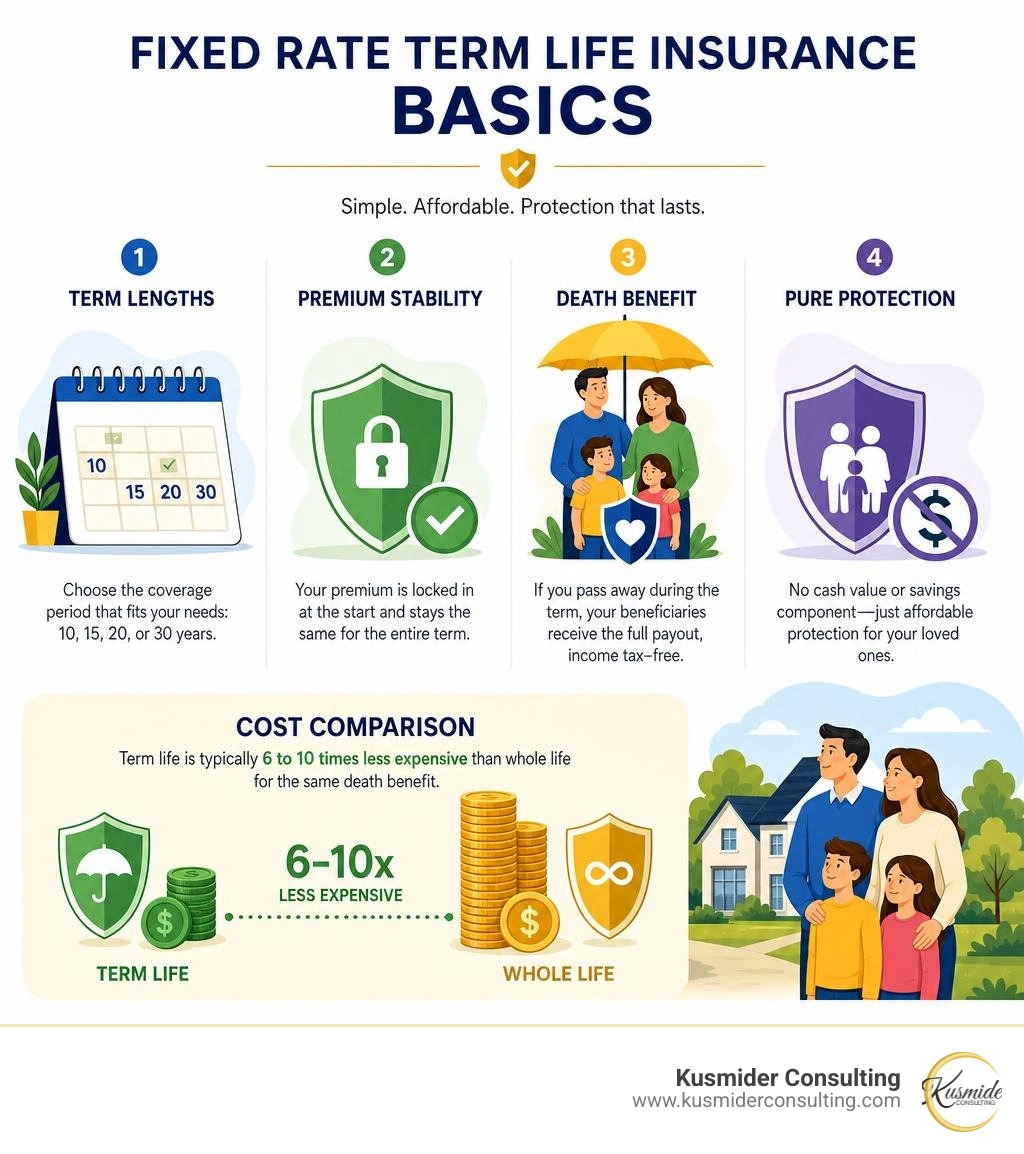
At its core, fixed rate term life insurance is built on predictability. When you purchase a policy, you enter into a contract with an insurance company. You agree to pay a set premium, and the insurer agrees to pay a specific death benefit to your beneficiaries if you pass away during the active term.
The defining characteristic of this policy is premium stability. The rate you pay in year one is exactly the same rate you pay in year ten, twenty, or thirty. This is why it is often referred to as level premium term insurance. It provides protection against the price increases that naturally occur as you age. To see how this compares to other structures, you can read our Term Insurance Plan Comparison.
To determine your premium, insurance companies put your application through an underwriting process. Underwriters assess your health, lifestyle, and medical history to assign you to a specific rate class. The standard rate classes include:
Securing a policy early in life allows you to lock in the lowest possible rates. If you are ready to take this step, our guide on why You Need Life Insurance explains the long-term benefits of securing coverage early.
When structuring your policy, the two most critical decisions you will make are the term length and the death benefit amount.
Most modern policies, such as the Premier Term portfolio, offer several level-premium guarantee periods:
The death benefit is paid out as a tax-free lump sum to your beneficiaries. This is a guaranteed 100% payout of the policy face amount, provided all premiums are paid and the death occurs within the term. This structure is vastly different from an Annually Renewable Term Policy, where premiums rise every single year as you age.
To decide if this insurance fits your financial plan, it helps to weigh its advantages and limitations.

The primary advantage is cost predictability. Because the premium is fixed, you can build it directly into your household or business budget without worrying about future price hikes. It is also highly budget-friendly, allowing you to secure substantial coverage for a fraction of the cost of permanent insurance.
The main drawback is that the coverage is temporary. If you outlive the term, the policy simply expires, and there is no payout or return of premiums. Additionally, these policies do not build cash value. Every dollar you pay goes strictly toward paying for the death benefit.
For families trying to balance protection with daily expenses, we dive deeper into these dynamics in our article on Life Insurance for Families. If you prefer to skip the medical exam process entirely, you may also want to explore No Medical Exam Life Insurance options.
If you outlive your term, you have three primary paths forward:
For military members or professionals with access to group benefits, options like the Group 10-Year Level Term Life Insurance - ROA offer distinct renewal structures, though individual policies generally provide more portable and customizable terms.
While term insurance is excellent for temporary needs, high-net-worth individuals and business owners often require more sophisticated, permanent structures.
At Kusmider Consulting, we look at insurance through a comprehensive planning lens. For clients over 45, life insurance is often integrated with long-term care planning. Rather than viewing long-term care as a medical issue, we treat it as a critical financial planning decision.
When planning for these costs, you have several primary vehicles:
It is vital to understand that relying on a Medicaid spend-down is not a proactive long-term care plan, but rather a last resort that requires exhausting personal assets before benefits begin.
When comparing policy types, the differences center on duration, cost, and cash value:
Permanent insurance is designed for lifelong obligations, such as funding a trust, paying estate taxes, or providing a guaranteed legacy.
For specialized clients, life insurance serves as a strategic business and estate tool:
For wealth managers and estate attorneys partnering with us, we focus on making these conversations natural. When speaking with clients, practical phrases can open the door: "Have you structured your business agreements to ensure your family is paid fully if you step away?" or "How are we planning to protect your portfolio from the impact of potential long-term care costs?" Your role as an advisor is simply to open the door; we handle the complex product design and implementation.
The ideal planning window for securing both life and long-term care protection is between the ages of 45 and 60. During this window, you still have maximum planning flexibility.
Consider the difference in flexibility between a healthy 50-year-old and a 64-year-old. A 50-year-old has access to the most favorable rate classes and highly efficient hybrid policies. By age 64, minor health changes or natural aging can double premium costs or limit the riders you can add to your policy.
To determine your basic term coverage needs, you can use the DIME formula:
At Kusmider Consulting, we help you navigate these calculations without sales pressure. We analyze your complete financial picture to design a strategy tailored to your exact needs. To learn more about how we support families and advisors in Houston, Texas, explore our Kusmider Consulting Services.
Long-term care is not a distant concern; it is a present planning opportunity. The families who handle it well are the ones who started the conversation early, explored their options with a clear head, and made a decision that fits their life. We are here to help make that process simple, not stressful.
Elizabeth works closely with wealth managers and estate attorneys to bring LTC planning into broader client conversations. To schedule a planning session or discuss a client situation, contact: Elizabeth Kusmider, CFP(r) | Elizabeth@Kusmiderconsulting.com
As a full-service, independent brokerage based in Houston, Texas and available throughout the U.S., we specialize in aligning insurance solutions with broader financial strategies. We provide expert guidance, unbiased product recommendations, and ongoing policy oversight to ensure your coverage evolves with your needs.
Whether you're reviewing your own protection or advising clients, we’re committed to helping you make informed, confident decisions.

Elizabeth founded Kusmider Consulting with a simple goal: help people make informed insurance decisions without confusion or pressure.
As a Certified Financial Planner™, she brings a planning background to insurance work, focusing on how coverage fits into the broader financial picture, not just policy features.
If you’d like to discuss how a topic applies to your personal or professional situation, we’re happy to talk.
Schedule a Planning callLife insurance planning for people who want clarity, structure, and long-term oversight.

Securities offered through Simplicity Investments, Member FINRA/SIPC; 475 Springfield Ave, Summit, NJ 07901 (303) 797-9080. Kusmider Consulting is not affiliated with Simplicity Investments.
The Leaders Group, Inc. Customer Relationship Policy
Broker Check by FINRA .