
What does buying life insurance for a child really accomplish in a family financial plan?
Child life insurance policies are permanent or term life insurance plans purchased for a minor, typically owned by a parent, grandparent, or guardian until the child reaches adulthood.
Here is a quick look at what these policies offer:
Most policies are available for children as young as 14 days old up to age 17, and many do not require a medical exam.
These are not just safety nets for worst-case scenarios. For many families, a child life insurance policy is a long-term planning tool that starts building value from day one. The earlier you start, the more that tool works in your child's favor. That gap between starting at birth versus waiting until adulthood can be meaningful, both in long-term cost and in flexibility.
I'm Elizabeth Kusmider, CFP®, founder of Kusmider Consulting, and I partner with wealth managers and estate attorneys to provide insurance planning for Business Owners and High-Income individuals. My work sits at the intersection of Modern Permanent Insurance, Estate & Legacy planning, and long-term financial security, and I have seen how early decisions for children can shape decades of financial outcomes.
When we sit down with families, the conversation often begins with a fundamental question: Is this about a death benefit, or is it about creating a financial head start? While the primary purpose of any insurance is protection, child life insurance policies can also function as a long-term planning asset.
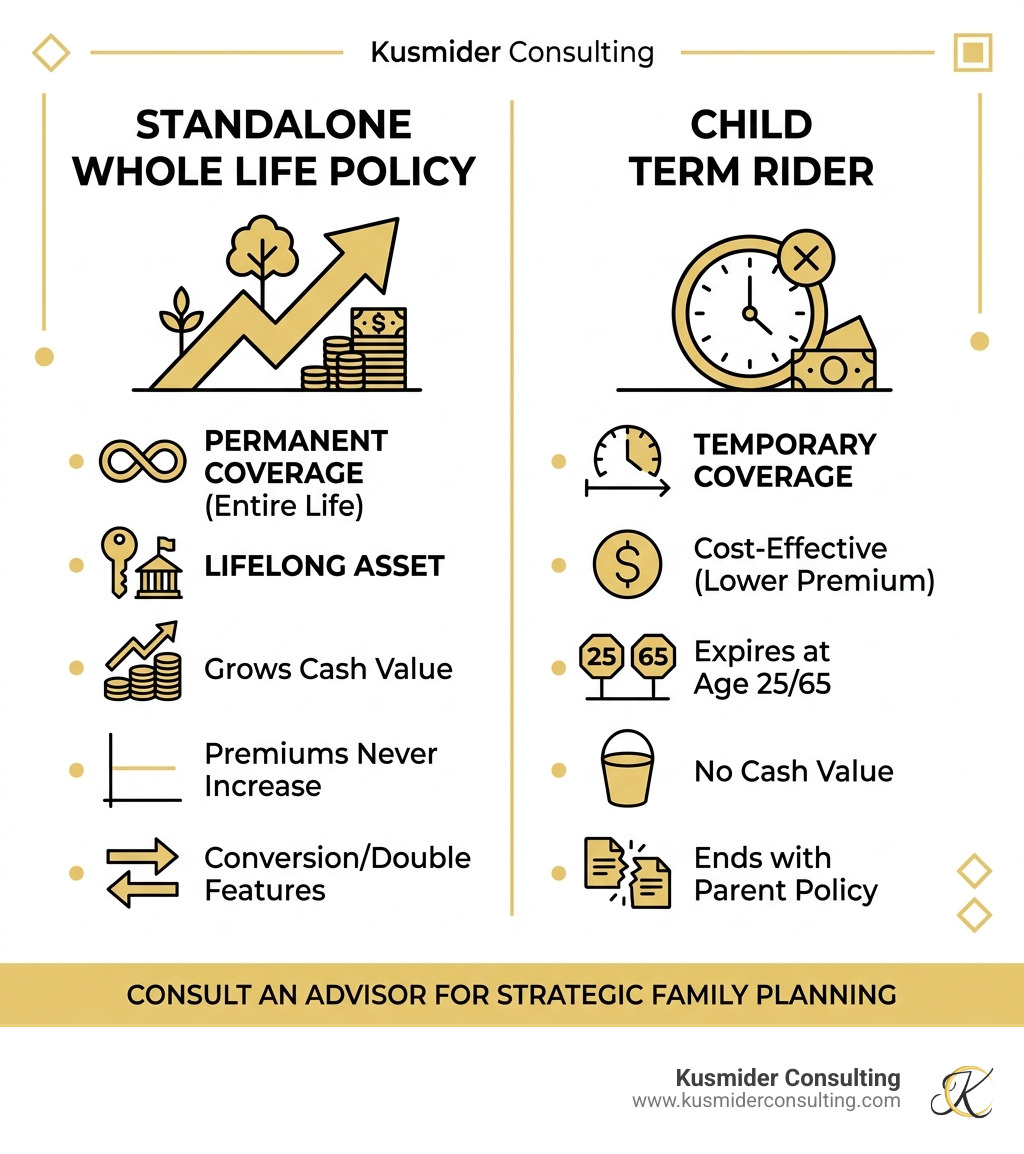
There are two primary vehicles used for this purpose. Permanent coverage, such as whole life, remains in place for the child’s entire life, provided premiums are paid. It features guaranteed level premiums that never increase and builds a cash component over time. Term Life Insurance for children is less common as a standalone product but frequently appears as a rider on a parent’s policy.
As noted in Life Insurance for Children | Aflac, these policies provide a critical Death Benefit that can range from $5,000 to $75,000. While no one wants to imagine the loss of a child, the financial reality is that funeral expenses can reach thousands of dollars. Having a policy in place allows a family the space to grieve without the immediate pressure of medical bills or final costs. However, our focus at Kusmider Consulting is often on the living benefits and the premium stability that comes with a direct planning approach.
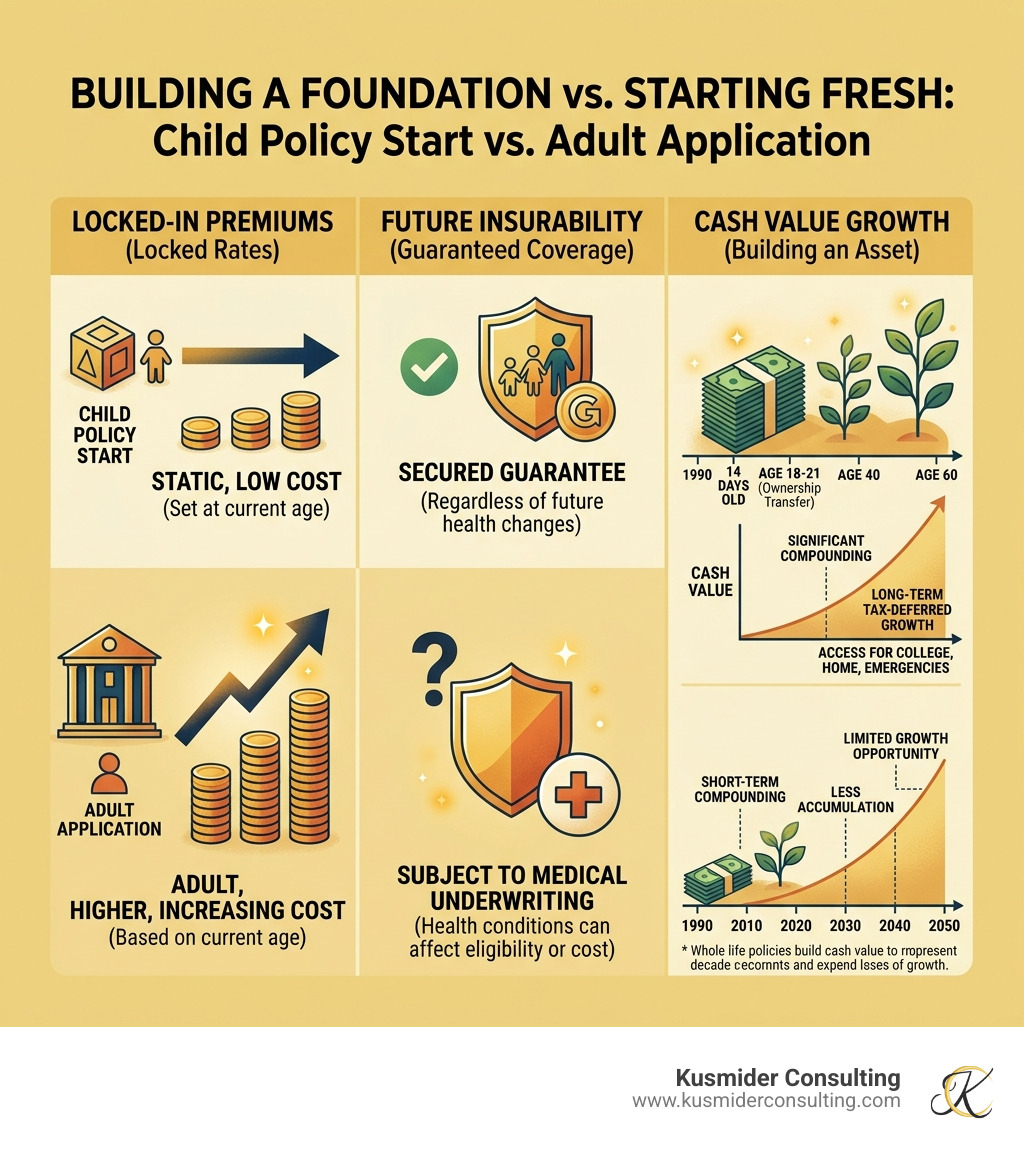
One of the most compelling reasons to consider coverage early is the Guaranteed Purchase Option. This is a rider that allows the child to purchase additional increments of coverage at specific ages such as 25, 30, and 40, or during major life events like marriage or the birth of their own child.
This is particularly relevant for Family History concerns. Medical underwriting for children is typically simplified, often requiring only a few health questions rather than a physical exam. By locking in coverage while a child is young and healthy, you help protect them against the risk of having fewer options later in life due to a diagnosis like diabetes or a heart condition. For High-Income families, this is a strategic move to help ensure that the next generation has access to the private insurance market, regardless of what their future health record looks like.
According to Life Insurance for Children: Benefits to Purchasing Coverage for Kids, the ability to bypass future medical exams is a gift of certainty in an uncertain world.
Beyond the death benefit, permanent child life insurance policies accumulate Cash Value. This is a portion of the premium that grows on a tax-deferred basis at a fixed interest rate.
For High-Income individuals and Business Owners, this cash value serves as a conservative, accessible bucket of liquidity. Once the policy has matured for several years, the owner, and eventually the child, can take policy loans against this value. These funds can be used for:
This provides a financial head start that traditional savings accounts often cannot match when you consider the tax advantages. To understand how this fits into your broader portfolio, you can see More info about our services.
Parents often ask us whether they should buy a standalone policy or simply add a child term rider to their own existing coverage. A rider is often the most cost-effective option. However, riders usually expire when the child reaches age 25 or the parent reaches age 65.
Modern Permanent Insurance, specifically standalone whole life or universal life, offers more robust features. The benefits are permanent. These policies often include conversion options and the "double feature" seen in some products where the coverage amount automatically doubles at age 18 with no increase in premium. For Business Owners looking for long-term strategic oversight, the standalone policy is usually the preferred vehicle because it survives the parent's policy and becomes a lifelong asset for the child.
At Kusmider Consulting, we view insurance through the lens of Estate & Legacy planning. We believe that every financial decision should preserve dignity and provide choice.
When we discuss Business Planning, we often look at how assets are structured for the long term. A common mistake in the industry is relying on Medicaid spend-down as a plan for future needs. Medicaid spend-down is not a long-term care plan, but a last resort that sacrifices dignity and choice. By building a foundation of private insurance early, you are providing the next generation with tools to maintain control over their financial future.
The planning window for these policies is broad but time-sensitive. Most insurers offer coverage for infants starting at 14 days old, with the upper limit for "child" rates typically being 17 years old.
The transition of ownership is a key milestone. While the parent or grandparent is the legal owner initially, the policy is designed to be transferred when the child reaches the Age of Majority, which is usually between 18 and 21 depending on the specific contract and state law. This transfer allows the young adult to take over a policy with a premium rate that was locked in when they were a toddler, a rate they could never obtain on the open market as an adult.
It is important to acknowledge that child life insurance policies are not a replacement for educational savings like 529 plans. Instead, they represent asset diversification.
A 529 plan is specifically tied to education expenses. If the child does not go to college, there may be penalties for withdrawal. The cash value in a life insurance policy, however, offers flexibility of use. Whether the child needs funds for a wedding, a business startup, or a house, the money is available without the restrictions of an education-specific account. In the context of Estate & Legacy planning, having multiple buckets of capital helps ensure the child has options regardless of the path they choose. You can learn more about our philosophy on our About Us page.
For advisors, this is often not about leading with product details. It is about opening the door to a planning conversation. A simple phrase can be: "This may not be the first tool we think about for a child, but it can create future flexibility, especially if insurability matters to your family." Another useful way to frame it is: "My role is to help identify planning opportunities. We can walk you through how the policy design works and whether it fits."
That collegial handoff matters. Advisors do not need to become product specialists to raise the issue thoughtfully. Kusmider Consulting handles the policy details, design options, and implementation conversations so families can make an informed decision in the context of their broader plan.
Elizabeth works closely with wealth managers and estate attorneys to bring insurance planning into broader client conversations. We are here to help make that process simple, not stressful. To schedule a planning session or discuss a client situation, reach out to Elizabeth Kusmider, CFP® at info@kusmiderconsulting.com.
As a full-service, independent brokerage based in Houston, Texas and available throughout the U.S., we specialize in aligning insurance solutions with broader financial strategies. We provide expert guidance, unbiased product recommendations, and ongoing policy oversight to ensure your coverage evolves with your needs.
Whether you're reviewing your own protection or advising clients, we’re committed to helping you make informed, confident decisions.

Elizabeth founded Kusmider Consulting with a simple goal: help people make informed insurance decisions without confusion or pressure.
As a Certified Financial Planner™, she brings a planning background to insurance work, focusing on how coverage fits into the broader financial picture, not just policy features.
If you’d like to discuss how a topic applies to your personal or professional situation, we’re happy to talk.
Schedule a Planning callLife insurance planning for people who want clarity, structure, and long-term oversight.

Securities offered through Simplicity Investments, Member FINRA/SIPC; 475 Springfield Ave, Summit, NJ 07901 (303) 797-9080. Kusmider Consulting is not affiliated with Simplicity Investments.
The Leaders Group, Inc. Customer Relationship Policy
Broker Check by FINRA .