
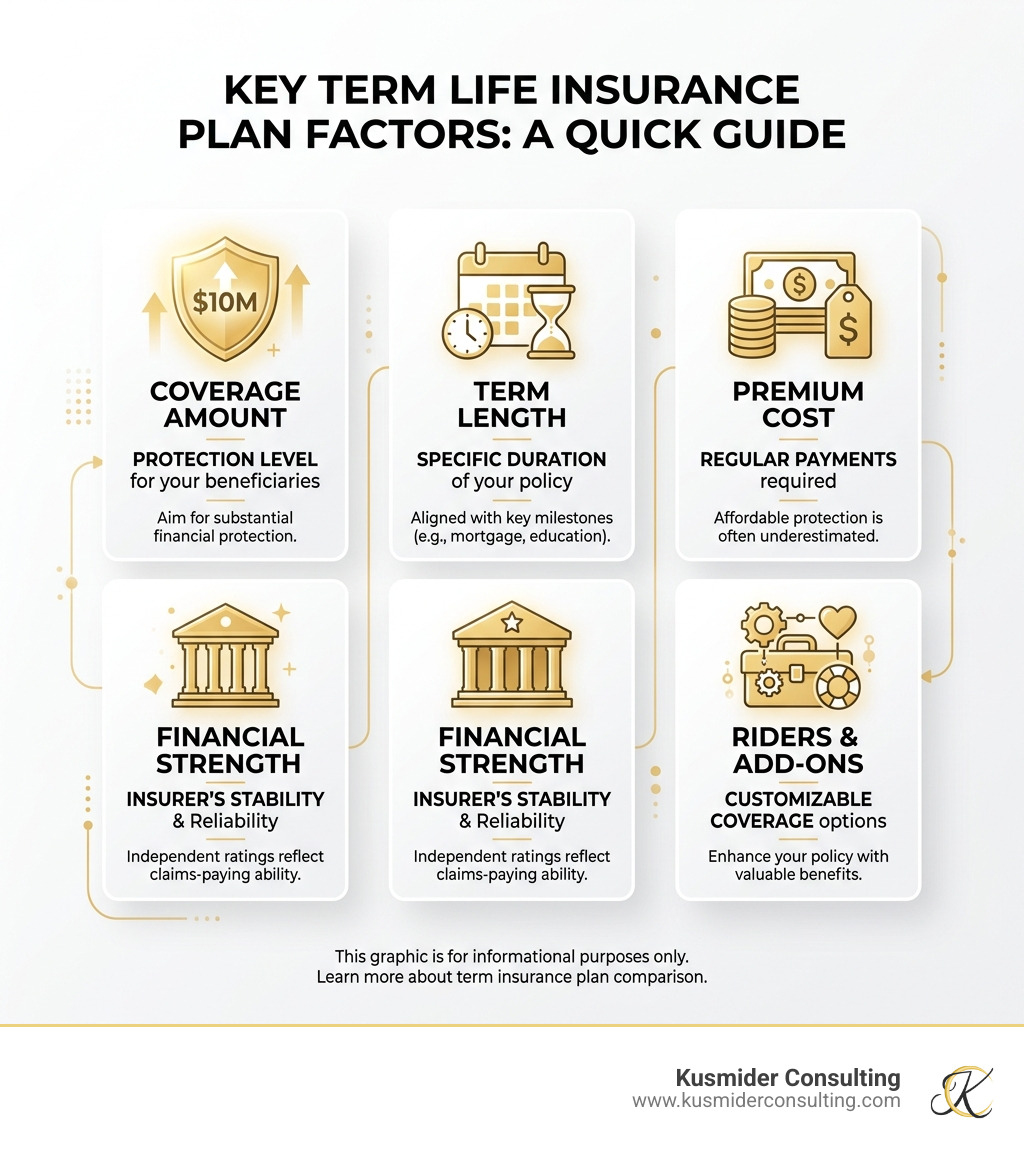
If your current coverage was built for an earlier stage of life, does it still reflect the financial plan you need today? A term insurance plan comparison is how you find the right policy for your life, your budget, and your family's actual needs. Here is a quick look at what matters most when comparing plans:
Coverage Amount: A common starting point is 10 to 15 times your annual income, then add major debts and future obligations.
Term Length: Choose a term that lines up with your biggest financial responsibilities, like a mortgage, income replacement period, or college costs.
Premium Cost: Compare affordability, but do not focus on price alone. The cheapest policy is not always the best fit.
Financial Strength: Check the insurer's AM Best rating. An A rating or better is a strong benchmark.
Claim Settlement Ratio: Higher is generally better. You want a carrier with a strong track record of paying valid claims.
Conversion Option: See whether you can move to permanent coverage later without taking a new medical exam.
Riders: Features like Accelerated Death Benefit and Waiver of Premium can make a policy much more useful.
Most people think term life costs far more than it actually does. Research from LIMRA found that the average person believes term life is about three times more expensive than it really is. That gap between perception and reality is exactly why so many families end up underinsured or delay buying coverage altogether.
The good news is that shopping smart, not just shopping cheap, gives you the protection your family needs without overpaying or missing critical details buried in the fine print.
I'm Elizabeth Kusmider, CFP® and founder of Kusmider Consulting. I partner with wealth managers and estate attorneys to help business owners, high-income individuals, and families age evaluate insurance within the broader context of financial planning. In the sections below, I will walk you through every key factor, from policy types and pricing to riders, conversion options, and the planning decisions that matter most.
If your current life insurance policy was designed for a version of you that no longer exists, is it still providing the protection your financial plan requires today? Insurance works best when it is aligned with the life you are building now. While Term Life provides a death benefit for a specific window, Modern Permanent Insurance offers lifelong protection and can support broader estate and legacy planning goals.
When performing a term insurance plan comparison, you will encounter three primary structures:
To calculate your needs, we often look at the DIME formula: Debt, Income replacement, Mortgage, and Education. Another method is Human Life Value, which adjusts coverage needs based on earning years and financial responsibilities.
For many households, term coverage is only one part of the conversation. Business Owners may need coverage tied to buy-sell planning or key person protection. High-Income Individuals often want insurance coordinated with estate and legacy goals. Family History can also shape the conversation, especially when clients want to preserve flexibility while they are still healthy.
Long-term care should be framed the same way: as a financial planning decision, not a health one. Options such as Standalone Long-Term Care, Hybrid Long-Term Care, and Life with LTC Rider can help clients protect assets and preserve choice. Medicaid spend-down is not a long-term care plan. It is a last resort that requires you to exhaust your assets, sacrificing dignity and choice.
Several personal factors dictate the results of your term insurance plan comparison. Age is one of the most important. The key planning window is ages 25-60. A healthy 35-year-old typically has far more flexibility in both product design and underwriting than a 64-year-old who waits to begin the conversation.
Beyond age, carriers look at:
A low premium means little if the company cannot pay the claim. We advise looking for AM Best ratings of A or higher. These ratings confirm a carrier's ability to meet long-term obligations. We also check the NAIC complaint index to see how a company treats its policyholders.
Riders are the features that allow you to customize your coverage:

For High-Income Individuals, a strategy called laddering can be highly effective. This involves buying multiple policies with different expiration dates to match specific milestones, such as a 10-year policy for a business loan and a 30-year policy for a mortgage.
Business Owners must also consider business continuity. If a key partner passes away, term insurance can provide the liquidity needed for a buy-sell agreement. When coordinated properly, coverage can support both business planning and personal estate objectives.
For advisors, this is often where a simple client conversation helps. You do not need to solve the product details in the first meeting. Practical ways to open the discussion include: "We should review whether your current coverage still fits your business and family obligations" or "This may be a good time to look at life and LTC planning together while you still have strong options." Your role is to open the door. Elizabeth can handle the product analysis, design options, and implementation details.
One of the most overlooked features in a term insurance plan comparison is the convertibility clause. This allows you to transition your term policy into Modern Permanent Insurance or a Life with Chronic Illness Rider policy without taking a new medical exam.
This is a practical hedge against future changes in health, planning goals, or estate needs. Permanent coverage builds cash value and is often a cornerstone of a robust estate and legacy plan.
The biggest mistake is delaying the purchase. The ages 25-60 planning window matters because a healthy 35-year-old usually has more options and better flexibility than a 64-year-old who waits. Other common errors include:
At Kusmider Consulting, we provide tailored coverage and long-term oversight to ensure your insurance matches your life. We believe in providing clarity without pressure, helping you see past the fine print to the protection that matters.
Elizabeth works closely with wealth managers and estate attorneys to bring insurance planning into broader client conversations. We are here to help make that process simple, not stressful. To schedule a planning session or discuss a client situation, reach out to Elizabeth Kusmider, CFP® at info@kusmiderconsulting.com.
As a full-service, independent brokerage based in Houston, Texas and available throughout the U.S., we specialize in aligning insurance solutions with broader financial strategies. We provide expert guidance, unbiased product recommendations, and ongoing policy oversight to ensure your coverage evolves with your needs.
Whether you're reviewing your own protection or advising clients, we’re committed to helping you make informed, confident decisions.

Elizabeth founded Kusmider Consulting with a simple goal: help people make informed insurance decisions without confusion or pressure.
As a Certified Financial Planner™, she brings a planning background to insurance work, focusing on how coverage fits into the broader financial picture, not just policy features.
If you’d like to discuss how a topic applies to your personal or professional situation, we’re happy to talk.
Schedule a Planning callLife insurance planning for people who want clarity, structure, and long-term oversight.

Securities offered through Simplicity Investments, Member FINRA/SIPC; 475 Springfield Ave, Summit, NJ 07901 (303) 797-9080. Kusmider Consulting is not affiliated with Simplicity Investments.
The Leaders Group, Inc. Customer Relationship Policy
Broker Check by FINRA .