
Life insurance for families is a coordinated set of policies and riders designed to protect every member of your household financially to support a household's future needs.
Here is a quick summary of what families need to know:
Most families are not covered by a single "family policy." Instead, the strongest plans layer individual policies with riders that extend protection to a spouse and children under one structure.
Planning during your 30s, 40s, and 50s gives you the most flexibility and the lowest rates. Waiting until your mid-60s significantly narrows your options. For a helpful overview of how life insurance works at a national level, see the National Association of Insurance Commissioners guide to life insurance.
I'm Elizabeth Kusmider, CFP® and founder of Kusmider Consulting, with a career built on helping families and business owners build protection strategies around life insurance for families that align with their broader financial goals. In the sections below, I'll walk you through how to design a plan that fits your household, your budget, and your long-term vision.
A strong financial blueprint requires a solid foundation to ensure the structure remains secure. This concept is the starting point for understanding the critical role of life insurance in a comprehensive household strategy. For high-income individuals and business owners, the goal is not just a death benefit, but the preservation of a legacy and the protection of those who depend on your economic value. The planning window between ages 35 and 60 is a pivotal time to secure these protections, as the flexibility of a healthy 50-year-old far exceeds the options available to a 64-year-old.
When we talk about life insurance for families, we aren't usually referring to one single document that covers everyone. Instead, we view it as a design process. We look at the specific roles each person plays and the financial requirements that would arise. For many in Houston, this means coordinating individual policies for adults with strategic riders for children.
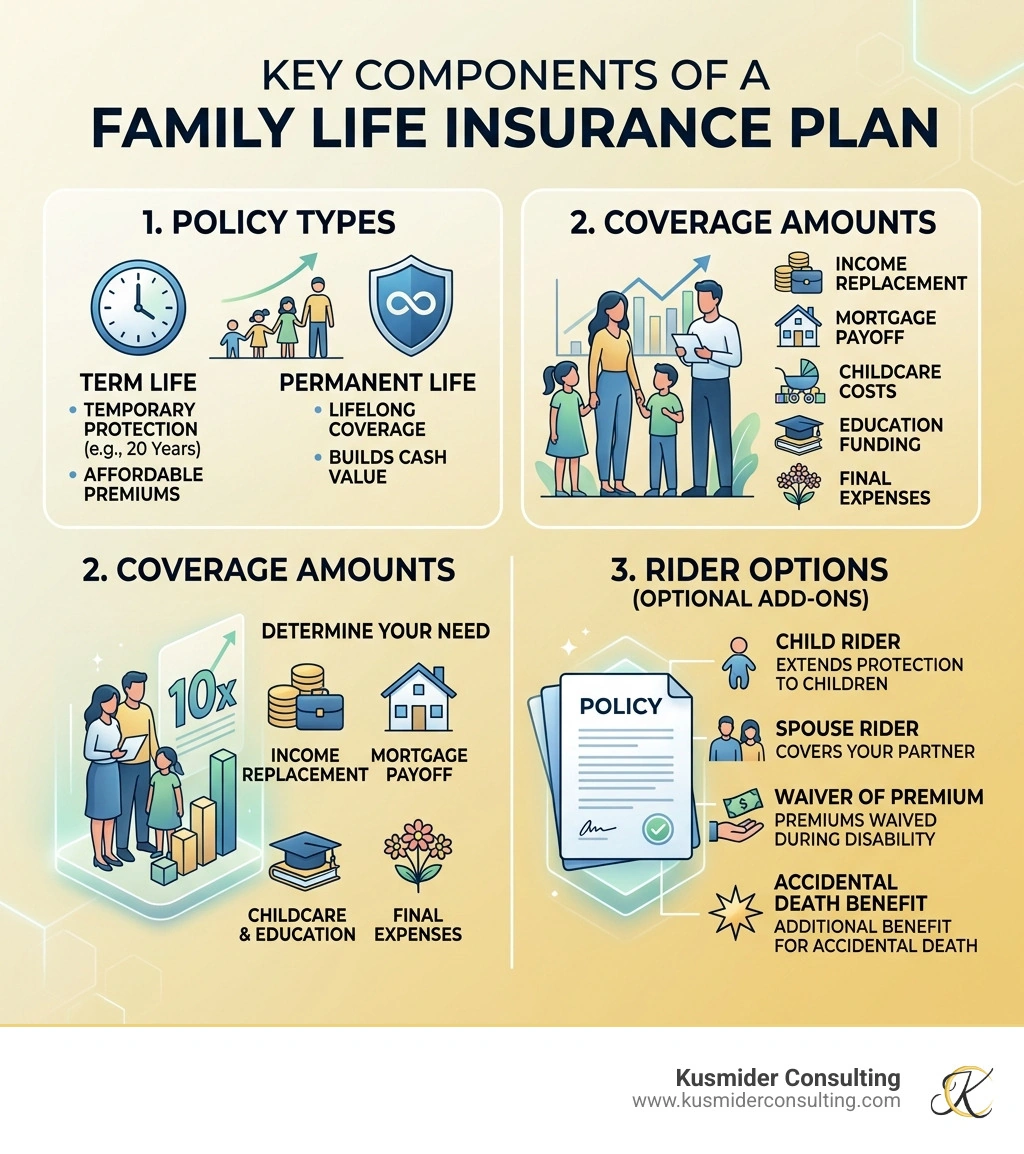
Choosing the right vehicle depends on whether you need temporary protection or a lifelong asset.
A common mistake we see is only insuring the primary breadwinner. However, planning for now and later requires recognizing the massive service replacement costs associated with a stay-at-home parent.
In the event of the loss of a non-earning spouse, the surviving parent often faces a bill of $4,000 to $5,200 per month just to outsource what was previously done by the parent at home. This includes childcare, household management, transportation, and eldercare. When we evaluate a family's needs, we look at the family history and domestic contributions to ensure this spouse has enough coverage to allow the surviving parent to continue working with financial stability.
While it is difficult to think about, insuring children is less about a "death benefit" and more about a "gift of insurability."
Other essential riders include the Waiver of Premium, which keeps the policy active if the payer becomes disabled, and the Accidental Death rider, which provides additional funds in the event of an unexpected event.
For families in the planning window, true security requires looking beyond immediate debt to the risks associated with aging and estate liquidity. We don't just plan for the "if" of death; we plan for the "when" of aging.
We believe that long-term care (LTC) is a financial planning decision, not a health one. As we discuss in our post on Long-Term Care Plans with Guarantees, there are several modern ways to handle this:
It is vital to understand that Medicaid spend-down is not a long-term care plan. It is a last resort that requires you to exhaust nearly all your assets, sacrificing dignity and choice in the process. We prefer to frame LTC as a wealth preservation tool that keeps your estate intact for your heirs.
To determine how much life insurance for families is truly enough, we look at the hard numbers. Consider these national averages that impact Houston families:
While the "10x income replacement rule" is a common benchmark, we prefer a deeper dive. We calculate the funds needed to "retire" the mortgage entirely, fund college for every child, and provide a cushion for the surviving spouse to take unpaid leave to grieve and reorganize the household.
At Kusmider Consulting, we help families design and manage these complex strategies. You can learn more About Us and Our Services on our website, or browse our Blog for deeper insights into estate protection.
Our unique value lies in providing clarity without sales pressure. We provide tailored coverage and, perhaps most importantly, long-term oversight. I often work as a collegial partner to wealth managers and estate attorneys. My role is to handle the intricate product details and underwriting nuances, while the advisor opens the door to these broader legacy conversations. We provide practical phrases for client conversations to ensure that every family member, from the newborn to the grandparent, is protected.
Elizabeth works closely with wealth managers and estate attorneys to bring insurance planning into broader client conversations. We are here to help make that process simple, not stressful. To schedule a planning session or discuss a client situation, reach out to Elizabeth Kusmider, CFP® at info@kusmiderconsulting.com.
As a full-service, independent brokerage based in Houston, Texas and available throughout the U.S., we specialize in aligning insurance solutions with broader financial strategies. We provide expert guidance, unbiased product recommendations, and ongoing policy oversight to ensure your coverage evolves with your needs.
Whether you're reviewing your own protection or advising clients, we’re committed to helping you make informed, confident decisions.

Elizabeth founded Kusmider Consulting with a simple goal: help people make informed insurance decisions without confusion or pressure.
As a Certified Financial Planner™, she brings a planning background to insurance work, focusing on how coverage fits into the broader financial picture, not just policy features.
If you’d like to discuss how a topic applies to your personal or professional situation, we’re happy to talk.
Schedule a Planning callLife insurance planning for people who want clarity, structure, and long-term oversight.
Securities offered through Simplicity Investments, Member FINRA/SIPC; 475 Springfield Ave, Summit, NJ 07901 (303) 797-9080. Kusmider Consulting is not affiliated with Simplicity Investments.
The Leaders Group, Inc. Customer Relationship Policy
Broker Check by FINRA .