Life insurance planning is the process of choosing, structuring, and managing life insurance coverage so it supports your broader financial goals, not just your family's immediate needs if you die.
Here is a quick overview of what effective life insurance planning involves:
Most people think of life insurance as a simple product you buy once and forget. But for families with significant assets, business owners, and high-income individuals, strategic planning is essential. Only 51% of Americans currently own any life insurance, and the average coverage gap sits at roughly $200,000 per household. Addressing this gap is a key part of wealth preservation. For a business owner with a multi-million dollar illiquid estate, or a family relying on a single high earner, structured planning ensures long-term financial stability.
Life insurance, when properly integrated, is a flexible financial tool. It can replace income, fund a business buyout, pay estate taxes, equalize an inheritance, and even cover long-term care costs. Proactive planning ensures that your wealth is preserved and transferred according to your wishes.
I'm Elizabeth Kusmider, CFP®, founder of Kusmider Consulting, where I specialize in helping business owners, families, and high-income individuals build insurance strategies that are fully integrated with their estate and financial plans. My work in life insurance planning is built around one goal: making sure every policy decision supports the broader strategy your advisors and attorneys have already put in place.
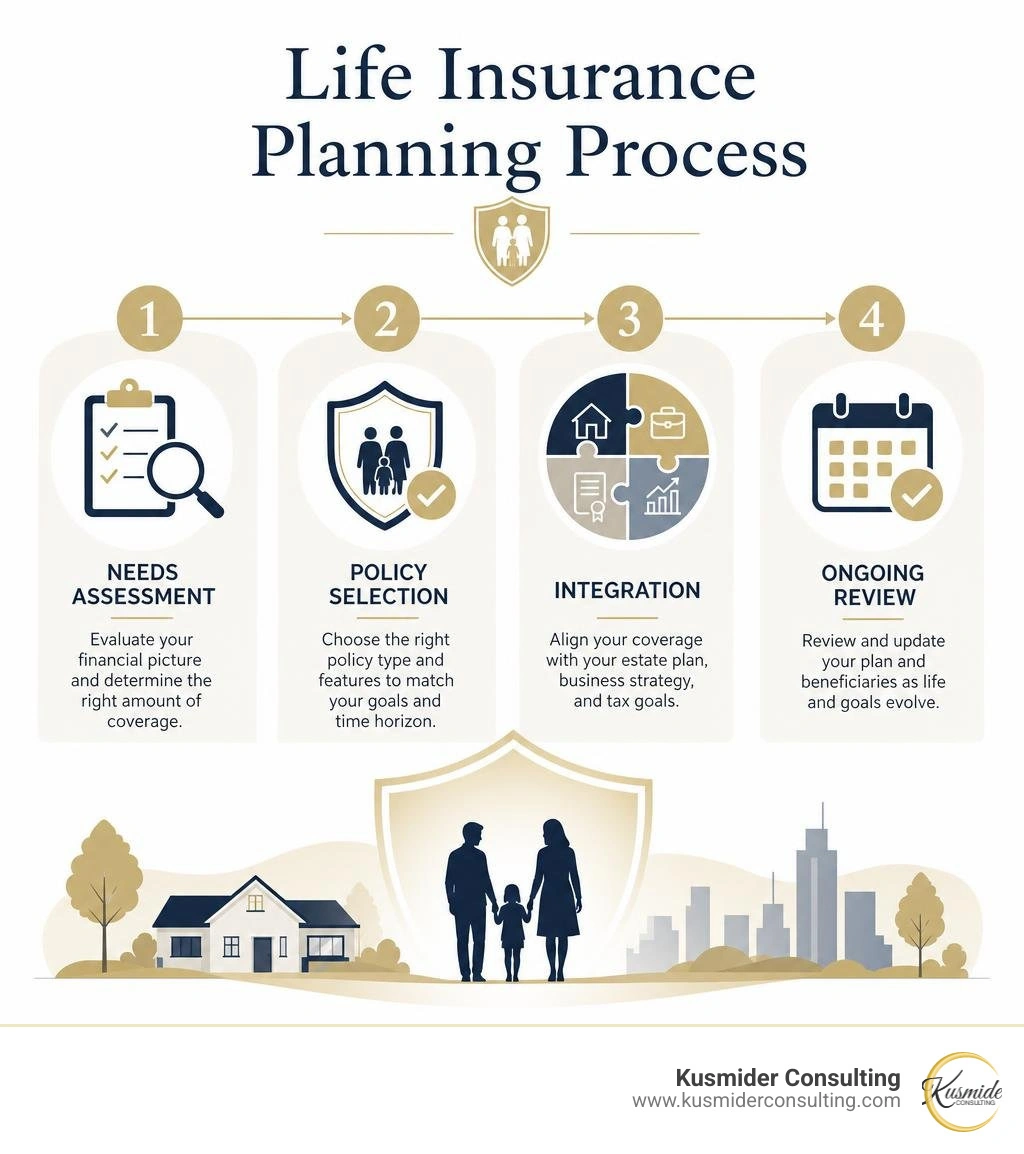
When we approach life insurance planning, we look beyond simple death benefits. True strategic planning treats life insurance as a foundational asset class that coordinates with tax planning, wealth transfer, and business continuity. Rather than viewing insurance as a standalone bill, we help you integrate it into a cohesive blueprint. For clients seeking comprehensive guidance, our structured approach to Insurance Planning ensures that your coverage aligns with your long-term wealth preservation goals.
To understand how different strategies fit into your plan, it helps to compare the core mechanisms of term and permanent policies:
| Feature | Term Life Insurance | Permanent Life Insurance |
|---|---|---|
| Coverage Duration | Defined period (typically 10 to 30 years) | Lifetime (as long as premiums are paid) |
| Premium Structure | Lower initial cost, level for the term | Higher initial cost, level or flexible |
| Cash Value Growth | None | Accumulates tax-deferred over time |
| Primary Use Case | Debt coverage, mortgage protection, child-rearing years | Estate liquidity, business succession, wealth transfer |
| Flexibility | Rigid term length, some offer conversion options | High (can borrow against cash value or adjust premiums) |
Many online calculators suggest buying a generic multiple of your salary, such as 10 to 12 times your annual income. While this is a simple starting point, it rarely suffices for complex financial situations. We prefer a more precise analysis.
To determine if your current coverage is truly sufficient, we recommend taking a Life Stress Test to evaluate how your plan holds up under real-world pressures. Understanding why You Need Life Insurance requires looking at your family's unique balance sheet, which is why tailored Life Insurance for Families must account for specific future obligations.
To build an accurate baseline, we use the DIME method:
For high-income profiles, we must also look at non-traditional liabilities, such as deferred compensation agreements, private school tuition, and vacation home maintenance. Additionally, family history considerations play a major role. If there is a family history of chronic illness, securing coverage early ensures optimal underwriting options and rate structures.
Choosing the right structure is a critical step in life insurance planning.
Term Life features straightforward, cost-effective protection for a set period. It is ideal for covering temporary liabilities like a 20-year mortgage or the years until your children graduate from college. However, over 97% of term policies never pay out a death benefit because the insured outlives the term.
For permanent needs, we look to policies that build equity. Whole Life guarantees a fixed premium, a guaranteed death benefit, and a guaranteed rate of cash value accumulation. Universal Life introduces premium and death benefit flexibility, allowing you to adjust payments as your cash flow changes. For those comfortable with market exposure, Variable Universal Life offers investment options that tie cash value growth directly to sub-accounts, though this requires active management.
The primary benefit of these permanent structures is the cash value growth mechanics. These policies enjoy tax-deferred growth benefits under Internal Revenue Code Section 7702, allowing assets to grow without annual tax drag. For high earners who have maxed out traditional retirement accounts, Permanent Life Insurance for High Earning Individuals serves as an efficient alternative vehicle for wealth accumulation. When shopping for these products, comparing options through resources like the Best Life Insurance Companies in Houston, TX (2025) or exploring regional solutions like Life insurance in Houston, Texas can help identify strong carriers.
How do you manage potential healthcare costs within your retirement portfolio without committing to a policy you might never use?
This is where modern permanent insurance excels. Traditional long-term care policies often felt inefficient because if you never needed care, the premiums did not provide a return. Today, we focus on Hybrid Life with LTC products. These policies combine a permanent death benefit with a long-term care rider. If you need care, the policy pays out tax-free living benefits to cover those costs. If you stay healthy, the full death benefit passes to your heirs.
When comparing a hybrid policy to a Standalone LTC policy, the hybrid option provides far greater utility. It provides premium stability and guarantees that your assets are preserved for your heirs if care is not needed.
We must be clear: relying on a Medicaid spend-down is not a plan, but a last resort. True planning is a proactive financial decision that preserves choice and control over your care. Securing a hybrid policy ensures you retain control over where and how you receive care, preserving both your assets and your independence.
For business owners profiles, life insurance is often the glue that holds a succession plan together.
If your wealth is concentrated in an illiquid family business, your estate may require liquidity when estate taxes come due. Federal estate taxes are due in cash nine months after death. Planning ahead avoids the need to sell a business under time pressure to meet these obligations.
By utilizing an Irrevocable Life Insurance Trust (ILIT), we can position a permanent policy to provide immediate liquidity to pay estate taxes, keeping the insurance proceeds entirely outside your taxable estate.
Additionally, life insurance solves the challenge of inheritance equalization. If one child wants to run the family business and another has no interest in it, you can leave the business to the active child and provide an equivalent financial benefit to the other through a life insurance death benefit. It also provides the necessary capital to fund buy-sell agreements, ensuring a smooth transition of ownership without draining company cash reserves. For local business owners, coordinating these strategies with local experts, such as Insurance Planning in Houston, can ensure your business remains protected under Texas law.
We do not operate in a vacuum. The most successful outcomes in life insurance planning occur when we collaborate directly with your existing team of professional advisors. We view our relationship with your CPA, wealth manager, and estate attorney as a collegial partnership.
We know that wealth managers and attorneys are busy managing complex portfolios and drafting legal documents. Our goal is to make it easy for you to introduce the insurance conversation. You do not need to be an expert in product design; your role is simply to open the door for the client.
For example, a wealth manager might say to a client: "We have structured a fantastic investment plan, but we should bring in an insurance specialist to make sure your family and business are fully insulated from unexpected risks." Once that door is open, we handle the product detail management, underwriting coordination, and policy design, keeping you fully informed at every step.
The optimal planning window for securing permanent coverage and long-term care protection is between the ages of 45 and 60.
During this window, you generally possess the financial capacity to fund these strategies, and your health is typically stable enough to secure preferred underwriting classifications.
The difference of a few years can be significant. Consider the flexibility of a healthy 50-year-old versus a 64-year-old:
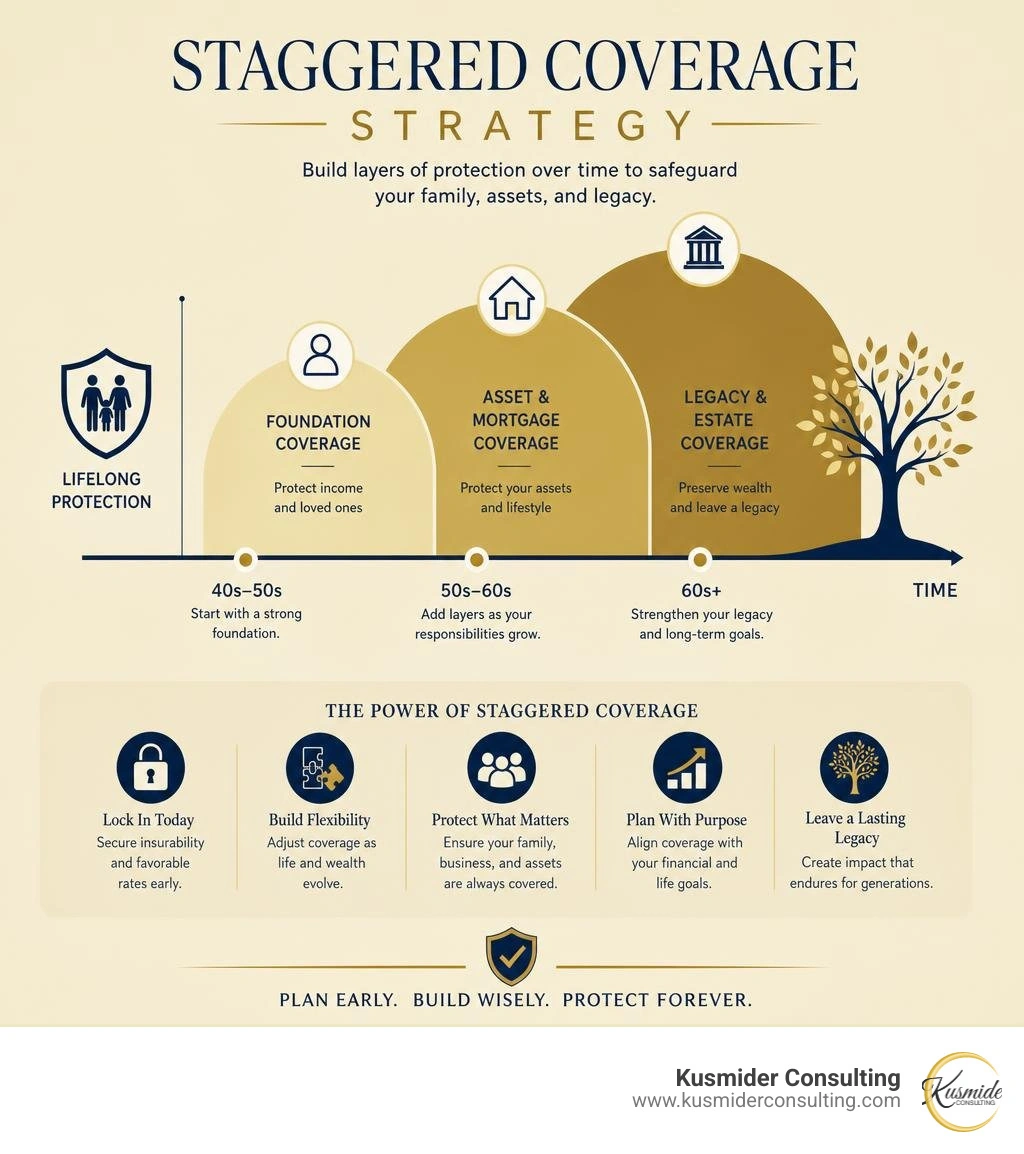
A 50-year-old has access to a wider array of products, lower premium rates, and more flexible underwriting options. By the time an individual reaches age 64, minor health changes or joint issues can lead to rated policies or limited options, which increases the cost of coverage. By staging your strategy early, you can lock in lower rates and establish a foundation that can be adjusted as your net worth grows.
Purchasing a policy is only the beginning of the planning process. Life insurance requires long-term oversight to ensure it continues to perform as intended. Interest rate shifts, changes in tax law, and major life events can all impact the health of your policy.
At Kusmider Consulting, we do not believe in "set-it-and-forget-it" insurance. We conduct regular policy reviews to monitor cash value performance, evaluate carrier financial strength, and verify that beneficiary designations remain accurate. Whether you are establishing a new policy or reviewing an existing one, our team is dedicated to providing ongoing, professional management. To learn more about how we support families and business owners through every stage of their financial journey, explore Our Services.
Long-term care is not a distant concern; it is a present planning opportunity. The families who handle it well are the ones who started the conversation early, explored their options with a clear head, and made a decision that fits their life. We are here to help make that process simple, not stressful.
Elizabeth works closely with wealth managers and estate attorneys to bring LTC planning into broader client conversations. To schedule a planning session or discuss a client situation, contact: Elizabeth Kusmider, CFP(r) | Elizabeth@Kusmiderconsulting.com | 713.487.8855
As a full-service, independent brokerage based in Houston, Texas and available throughout the U.S., we specialize in aligning insurance solutions with broader financial strategies. We provide expert guidance, unbiased product recommendations, and ongoing policy oversight to ensure your coverage evolves with your needs.
Whether you're reviewing your own protection or advising clients, we’re committed to helping you make informed, confident decisions.

Elizabeth founded Kusmider Consulting with a simple goal: help people make informed insurance decisions without confusion or pressure.
As a Certified Financial Planner™, she brings a planning background to insurance work, focusing on how coverage fits into the broader financial picture, not just policy features.
If you’d like to discuss how a topic applies to your personal or professional situation, we’re happy to talk.
Schedule a Planning callLife insurance planning for people who want clarity, structure, and long-term oversight.

Securities offered through Simplicity Investments, Member FINRA/SIPC; 475 Springfield Ave, Summit, NJ 07901 (303) 797-9080. Kusmider Consulting is not affiliated with Simplicity Investments.
The Leaders Group, Inc. Customer Relationship Policy
Broker Check by FINRA .