
If your policy faced a sudden shift in returns, loan costs, or cash value performance today, would the protection you planned for your family still hold up?
A life insurance stress test is a structured review that checks whether your policy can hold up under real financial pressure, including outstanding loans, interest charges, and shifts in cash value.
Quick answer: What does a life insurance stress test look at?
Whole Life Insurance policies are often marketed as flexible financial tools. And they can be. But a loan against your policy is not free money. It reduces your death benefit. It can create lapse risk. And if left unmanaged, it can quietly undo years of premium payments.
Most policyholders do not realize the problem exists until it becomes harder to correct.
Stress testing is simply a disciplined way to review resilience before a problem becomes expensive. That principle applies whether you are reviewing a large institution or a household balance sheet.
I'm Elizabeth Kusmider, CFP®, and my work at Kusmider Consulting is built around helping families, Business owners, and High-income individuals find the gaps in their financial protection strategies before those gaps become costly. Applying a life insurance stress test lens to client portfolios is a core part of how I help clients make sure their coverage still does what they originally intended it to do.
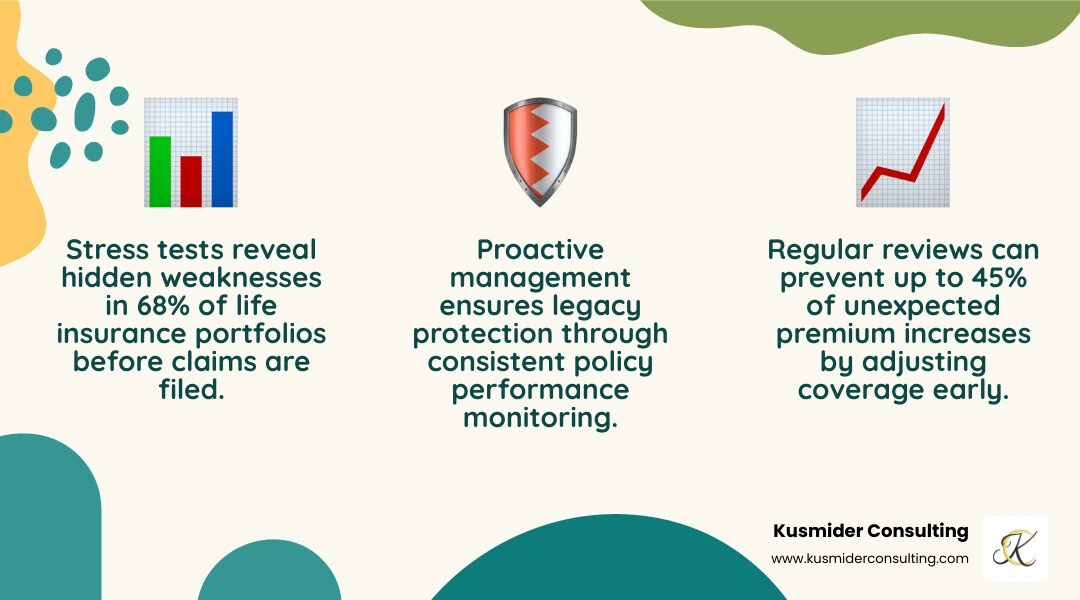
A policy illustration is a snapshot. A life insurance stress test is a weather report.
We use this kind of review to ask simple but important questions: What happens if loan interest keeps compounding? What if cash value growth slows? What if the insured wants to reduce premiums later? What if the policy is supposed to support retirement income, Estate & Legacy, or Business Planning?
In the broader insurance world, stress tests are designed to evaluate resilience under pressure. Regulatory bodies routinely apply stress testing frameworks to assess the financial health of insurers, as outlined by the National Association of Insurance Commissioners (NAIC). That same planning mindset is useful for personal coverage. For broader planning context, we also encourage clients to read more about planning for now and later.
With Whole Life Insurance, the challenge is often gradual. A policy loan may solve a short-term need, but it creates a long-term math problem.
A proper review looks at:
For families, this matters because the policy you intended as a legacy tool may gradually become a much smaller asset than expected. For parents and grandparents funding coverage for younger generations, this is one more reason to understand policy mechanics clearly. You can explore related planning considerations in our article on child life insurance policies.
A stress test is where we move from "the policy is in force" to "the policy still works."
Lapse risk is one of the easiest policy issues to overlook. To be clear, it is important to understand, a loan on a policy does not pay the interest to the insured or their cash value. It adds to the total outstanding loan amount and pays interest to the carrier. This is where a build up of loan interest can lead to a lapse.
When a loan balance grows faster than the policy's internal value, the contract can become less flexible. If enough cash value is consumed by loan interest, insurance costs, or weak crediting, the policy may need additional premium just to stay in force.
For personal planning, the principle is straightforward:
There is a major difference between reviewing coverage at 50 and trying to repair it at 64.
High-income individuals and Business owners often have more moving parts: estate goals, buy-sell obligations, key person needs, retirement income planning, and long-term care exposure. That is why we emphasize the planning window of ages 35 to 60.
A healthy 50-year-old usually has more flexibility to:
A 64-year-old may still have good options, but usually with less pricing flexibility and less room for mistakes.

The practical version is this: time is a feature. Compound growth can be helpful when it is working for you and frustrating when it is working for your loan.
A stress-tested portfolio is not just about avoiding failure. It is about protecting intent.
If your policy was meant to support Estate & Legacy goals, family liquidity, or Business Planning, then ongoing review matters. We help clients do that with clarity and without sales pressure. Sometimes the answer is to keep the policy and manage it better. Sometimes it is to reposition coverage. Sometimes it is to pair life insurance with other planning tools so one policy is not forced to do every job badly.
For readers looking at additional solutions and broader care planning, here is more information about long-term care plans with guarantees.
Policyholders face their own version of concentration risk when one overused policy loan starts doing too much damage.
We regularly partner with wealth managers and estate attorneys. If you are an advisor, your role is not to become the product specialist overnight. Your role is to open the conversation well, and Elizabeth can handle the product details.
A few practical ways to start:
That kind of conversation creates clarity without creating panic.
If you want to see how we approach these planning conversations more broadly, visit our services or browse the Kusmider Consulting blog.
Elizabeth works closely with wealth managers and estate attorneys to bring insurance planning into broader client conversations. We are here to help make that process simple, not stressful. To schedule a planning session or discuss a client situation, reach out to Elizabeth Kusmider, CFP® at info@kusmiderconsulting.com.
As a full-service, independent brokerage based in Houston, Texas and available throughout the U.S., we specialize in aligning insurance solutions with broader financial strategies. We provide expert guidance, unbiased product recommendations, and ongoing policy oversight to ensure your coverage evolves with your needs.
Whether you're reviewing your own protection or advising clients, we’re committed to helping you make informed, confident decisions.

Elizabeth founded Kusmider Consulting with a simple goal: help people make informed insurance decisions without confusion or pressure.
As a Certified Financial Planner™, she brings a planning background to insurance work, focusing on how coverage fits into the broader financial picture, not just policy features.
If you’d like to discuss how a topic applies to your personal or professional situation, we’re happy to talk.
Schedule a Planning callLife insurance planning for people who want clarity, structure, and long-term oversight.

Securities offered through Simplicity Investments, Member FINRA/SIPC; 475 Springfield Ave, Summit, NJ 07901 (303) 797-9080. Kusmider Consulting is not affiliated with Simplicity Investments.
The Leaders Group, Inc. Customer Relationship Policy
Broker Check by FINRA .