
What if the real question is not whether you need permanent life insurance, but how to secure it without putting unnecessary pressure on cash flow during an important planning season?
Modified whole life insurance is a type of permanent life insurance that starts with lower premiums for a set number of years, then increases to a higher fixed rate for the rest of your life, while keeping the same death benefit throughout.
Here is a quick breakdown of how it works:
This structure can appeal to people who want permanent protection while preserving flexibility in the early years. It is not the right fit for everyone, but in the right financial situation, it can be a practical planning tool.
Understanding the trade-offs clearly is what helps turn an insurance decision into a sound planning decision.
I'm Elizabeth Kusmider, CFP® and Founder of Kusmider Consulting, and I work with wealth managers, estate attorneys, business owners, and high-income individuals, especially those age 45 and older, to evaluate permanent insurance and long-term care strategies as part of a broader financial and estate planning framework. In this guide, I will walk you through how modified whole life insurance works, who it may serve well, and where other options may be a stronger fit.

Discover more about modified whole life insurance:
When we design thoughtful wealth strategies, we often begin with a simple question: How can we secure permanent protection today without limiting flexibility during an important growth phase? For many high-income earners and business owners, managing current cash flow is a planning priority, even when long-term goals are clear. This is where modified whole life insurance enters the conversation.

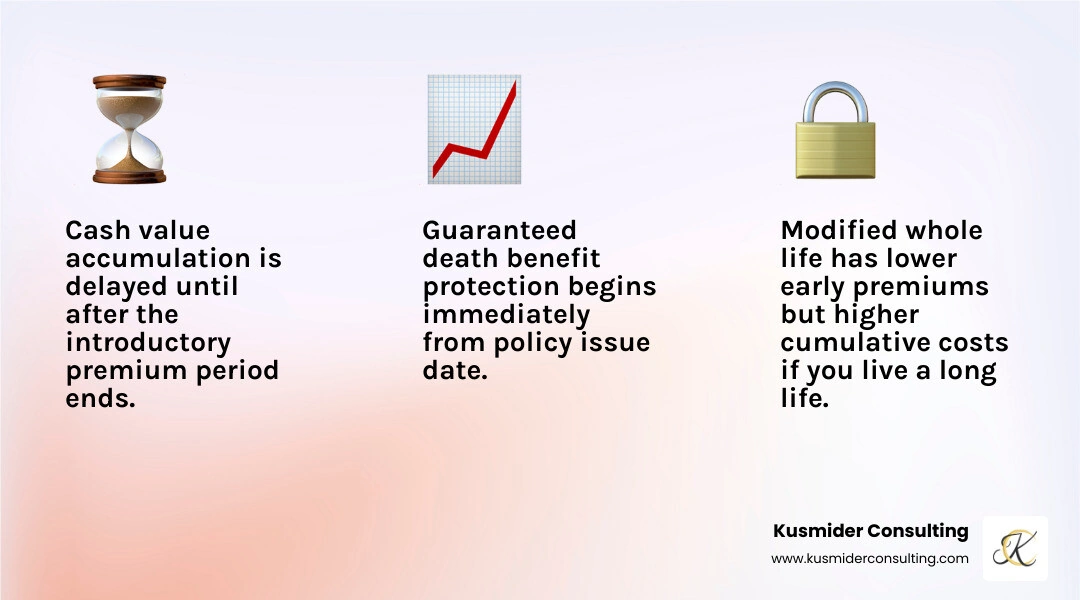
A modified policy is structured with a two-phase premium schedule. During the introductory period, which typically spans three to ten years, the policyholder pays a reduced rate. Once this period ends, the premium steps up to a higher, permanent level. The death benefit remains constant from the first day, provided the policy is fully underwritten.
However, it is important to distinguish between a modified premium policy and a modified benefit policy. In a modified benefit structure, often sold as guaranteed acceptance final expense insurance, there is typically a two to three year waiting period before the full death benefit is paid for natural causes of death. If death occurs during this waiting period, the beneficiary may only receive a refund of premiums plus interest. Understanding these differences is essential, especially when comparing these structures to more flexible forms of modern permanent insurance such as those detailed in the Scientific research on variable universal life structures.
To understand this structure, we need to compare it directly to standard permanent coverage. Under traditional whole life insurance, you pay level premiums that remain unchanged from the day you sign the contract until the policy matures.
With modified whole life insurance, you are choosing a stepped payment structure. The initial lower premium acts as a temporary bridge. When the step-up occurs, the new premium is higher than what you would have paid for a traditional policy purchased at the same starting age. This is because the insurance company must make up for the lower payments received during the introductory years.
Premium structure: Traditional Whole Life Insurance usually has level, fixed premiums from day one. Modified Whole Life Insurance starts lower for 2 to 10 years, then increases permanently.
Initial cost: Traditional policies require a higher upfront commitment. Modified policies cost less during the introductory phase.
Long-term cost: Traditional whole life may have lower total premiums over time. Modified whole life can cost more if you keep the policy for many years.
Cash value growth: Traditional whole life starts building cash value right away. Modified whole life often has slower or minimal growth during the early years.
Underwriting: Traditional policies often use standard or more rigorous medical underwriting. Modified policies vary, from full underwriting to guaranteed issue.
For a detailed look at how these permanent options stack up against temporary coverage, you can review our Term Insurance Plan Comparison.
One of the most significant trade-offs of a modified policy involves its cash value accumulation. Because early premiums are lower, less capital is available to build the policy's cash reserve. In fact, many modified policies do not allow meaningful cash value accumulation during the initial phase.
As a result, cash value growth is delayed and typically begins in a more meaningful way only after the premium increase period. For high-income planners who view permanent life insurance as part of a liquidity, estate, or legacy strategy, this delay can be a disadvantage. While you still may benefit from tax-advantaged growth and the ability to take policy loans later in life, the early compounding years are reduced.
For families focused on immediate asset protection and risk management, we explore these dynamics further in our guide on Family Risk Management Insurance.
Every financial tool has a purpose. For high-income professionals and business owners, evaluating modified whole life insurance means weighing near-term flexibility against long-term efficiency.
The Pros:
The Cons:
To understand how these pros and cons fit into a broader family security plan, read our article on Life Insurance for Families.
What if the bigger planning opportunity is not just choosing the right life insurance policy, but using it to protect your estate, your family, and your future choices?
For many clients, particularly those in the planning window between ages 45 and 60, permanent insurance is not just about a death benefit. It is about estate & legacy planning, preserving assets, supporting business planning, and preparing for the financial impact of long-term care.
When we talk about estate planning, we also have to address the realities of aging and future care costs. Long-term care should be framed as a financial planning decision, not a health decision. We must also be clear: Medicaid spend-down is not a long-term care plan. It is a last resort that limits options and control regarding where and how care is received. To protect your estate and maintain control, other permanent and long-term care structures should be evaluated early.
If the rigid step-up structure of a modified policy feels too restrictive, Variable Universal Life Insurance or other flexible-premium modern permanent insurance options may be more appropriate. These policies allow you to adjust premiums and death benefits over time as your financial picture changes.
To determine if your current coverage or a proposed policy can withstand changing economic conditions, we recommend performing a Life Insurance Stress Test. This process helps evaluate how different premium structures perform over time. You can learn more about these versatile structures in our overview of Flexible Premium Life Options.
For high-income individuals and business owners, long-term care is fundamentally a financial planning decision. It is about protecting assets, preserving options, and reducing the risk that future care costs disrupt an estate or legacy plan.
The planning window is often between ages 45 and 60. A healthy 50-year-old typically has far more flexibility, better pricing, and more product choices than a 64-year-old whose health or insurability may have changed. That difference matters when building a strategy that needs to support both lifetime protection and future care needs.
When integrating this protection into an estate plan, we typically evaluate three primary pathways:
To explore how these guaranteed structures support wealth preservation, read Long Term Care Plans with Guarantees Yes It's Possible.
At Kusmider Consulting, we believe in providing clarity without pressure. We work closely with families, business owners, and their trusted advisors to design, review, and manage specialized insurance and long-term care strategies.
Our advisor partnership model is built on collaboration. We partner with wealth managers and estate attorneys to bring sophisticated life insurance and long-term care planning into broader client conversations. If you are an advisor, your role is to open the door. You do not need to master the product details before raising the issue.
A few practical ways to start the conversation with clients include:
From there, Elizabeth handles product design, underwriting coordination, and long-term oversight so you can stay focused on the broader client relationship. To learn more about how we support both clients and professional advisory teams, please explore our services.
Long-term care is not a distant concern; it is a present planning opportunity. The families who handle it well are the ones who started the conversation early, explored their options with a clear head, and made a decision that fits their life. We are here to help make that process simple, not stressful.
Elizabeth works closely with wealth managers and estate attorneys to bring LTC planning into broader client conversations. To schedule a planning session or discuss a client situation, contact: Elizabeth Kusmider, CFP(r) | Elizabeth@Kusmiderconsulting.com
As a full-service, independent brokerage based in Houston, Texas and available throughout the U.S., we specialize in aligning insurance solutions with broader financial strategies. We provide expert guidance, unbiased product recommendations, and ongoing policy oversight to ensure your coverage evolves with your needs.
Whether you're reviewing your own protection or advising clients, we’re committed to helping you make informed, confident decisions.

Elizabeth founded Kusmider Consulting with a simple goal: help people make informed insurance decisions without confusion or pressure.
As a Certified Financial Planner™, she brings a planning background to insurance work, focusing on how coverage fits into the broader financial picture, not just policy features.
If you’d like to discuss how a topic applies to your personal or professional situation, we’re happy to talk.
Schedule a Planning callLife insurance planning for people who want clarity, structure, and long-term oversight.

Securities offered through Simplicity Investments, Member FINRA/SIPC; 475 Springfield Ave, Summit, NJ 07901 (303) 797-9080. Kusmider Consulting is not affiliated with Simplicity Investments.
The Leaders Group, Inc. Customer Relationship Policy
Broker Check by FINRA .