
Lapse life insurance recovery is possible in more situations than most families realize, and acting quickly makes all the difference. Here is a quick overview of your main options:
About 20% of life insurance policies lapse within the first three years. Most of the time, the cause is something ordinary: a missed payment, a banking change, or a health event that disrupted normal routines. What feels like a permanent loss of coverage often is not. State law requires insurers to follow strict notice and grace period procedures before a policy can legally lapse, and when those rules are not followed, families have real options to recover benefits.
I'm Elizabeth Kusmider, CFP(r), and through my work at Kusmider Consulting, I have spent years helping families and business owners navigate complex insurance decisions, including lapse life insurance recovery situations where the path forward was not obvious at first. If you are reviewing this topic for yourself or a loved one, the sections below will walk you through exactly what your rights are and what steps to take.
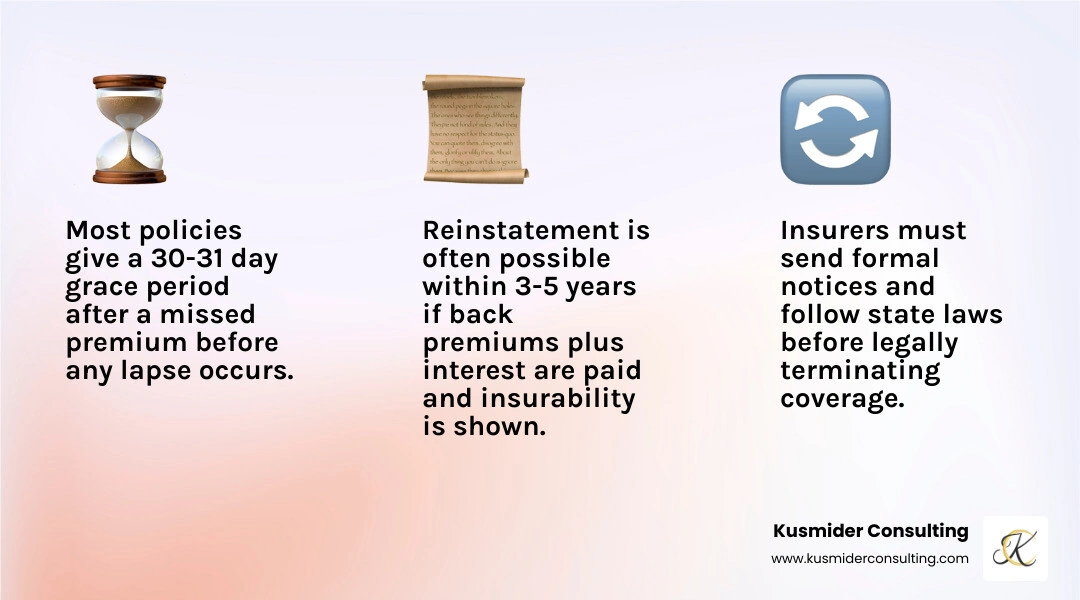

When a policy is flagged as "lapsed," it is important to review the specific notice requirements and state-mandated protections. Insurers must follow strict notice requirements and state-mandated protections before a policy is terminated. There are procedural safeguards that must be satisfied first.
A wrongful denial often occurs when an insurance company fails to follow these procedural safeguards. For instance, if the insurer sent a notice to an old address or failed to notify a secondary designee, the lapse might be legally invalid. Understanding these rules is the first step in Lapsed Life Insurance Policy: Can You Still Collect? | Attorney Guide : Life Insurance Lawyer.
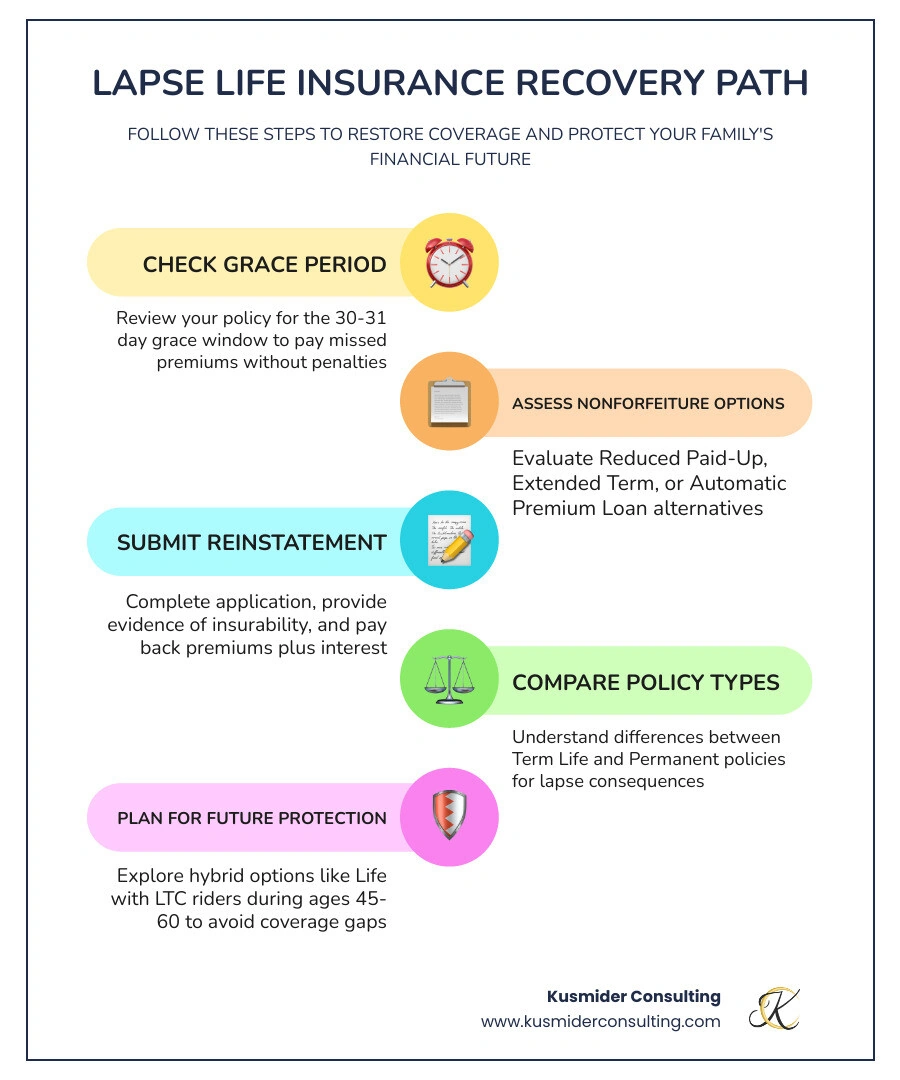
Every life insurance policy includes a grace period. This is a 30 to 31-day window following a missed premium payment during which the policy remains fully in force. If the insured person passes away during this period, the insurer is legally required to pay the death benefit, though they will typically subtract the overdue premium from the final payout.
For Business Owners and High-Income Individuals, a lapse can be addressed through careful review of succession plans or estate liquidity. In some cases, especially with newer regulations, this grace period may even be extended to 60 days. It is vital to verify the specific language in your contract and the laws of your state to ensure your family risk management insurance remains intact.
State laws vary significantly, but they generally lean toward protecting the consumer. In California, for example, Insurance Code §10113.71 requires a 60-day grace period and mandates that insurers give policyholders the right to designate at least one other person to receive notice of lapse or termination for nonpayment. If the insurer failed to offer this annual designee right, the lapse can often be overturned.
In Florida, there are specific protections for elderly policyholders. Insurers may be required to notify a secondary contact before canceling a policy held by someone over a certain age. These protections exist because a lapse is often a symptom of a larger issue, such as a health crisis or cognitive decline, rather than a conscious choice to stop coverage. You can find more details on these rights in this guide on what to do if a life insurance policy lapses.
If you are a beneficiary and a claim has been denied due to an alleged lapse, do not take the insurer's word for it. The first step is to request the complete claim file and the formal denial letter. This file contains the history of premium payments, copies of all lapse notices sent, and the addresses used for those notices.
Wrongful denials often stem from insurer procedural failures or simple administrative errors, such as mailing notices to an incorrect address or ignoring a secondary addressee on file. We often recommend a life insurance stress test to identify these vulnerabilities before they become a crisis, but after a death, a thorough review of the claim file is your best tool for recovery.

If the policyholder is still living, the path to lapse life insurance recovery is usually through reinstatement. Reinstating a policy is often more cost-effective than buying a new one because it preserves the original premium rates based on the age when the policy was first issued.
Most insurance contracts allow for a reinstatement window of 3 to 5 years. To bring a policy back to life, you generally must:
For those with Modern Permanent Insurance, the process is a way to reclaim accumulated cash value that might otherwise be lost. It is important to note that reinstatement often resets the two-year contestability period and the suicide clause. This means the insurer has a fresh window to investigate the medical history provided on the reinstatement application. Planning for future protection requires being meticulously honest during this process to avoid future claim denials.
Permanent policies (Whole Life or Universal Life) often have "nonforfeiture" values. If you stop paying premiums, the policy doesn't always just vanish. You might have options like:
| Feature | Term Life | Permanent (Whole/Universal) |
|---|---|---|
| Grace Period | 30-31 Days | 30-31 Days |
| Cash Value | None | Accumulates over time |
| Lapse Consequence | Coverage ends completely | May trigger nonforfeiture options |
| Reinstatement | Requires proof of health | Uses cash value or back payments |
| Tax Impact | Usually none | Potential tax on unpaid loans |
Understanding these flexible premium life options is essential for maintaining a stable financial plan.
At Kusmider Consulting, we believe the best lapse life insurance recovery strategy is a proactive one. This is especially true when discussing Long-Term Care (LTC). We often see families wait too long, only to find that their options have narrowed significantly.
The planning window for LTC is typically between ages 45 and 60. A healthy 50-year-old has access to a wide range of Modern Permanent Insurance products with a Life with LTC rider. These "hybrid" policies ensure that if you don't use the LTC benefit, your family still receives a death benefit. Compare this to a 64-year-old who may have developed health issues; their premiums will be higher, and their choices will be fewer.
It is important to remember that Medicaid spend-down is not a long-term care plan. It is a last resort that requires you to exhaust nearly all your assets, which can limit your choice in where and how you receive care. By integrating LTC planning into your broader financial strategy early, you protect your estate from being drained by healthcare costs.
Long-term care is not a distant concern; it is a present planning opportunity. The families who handle it well are the ones who started the conversation early, explored their options with a clear head, and made a decision that fits their life. We are here to help make that process simple, not stressful.
Elizabeth works closely with wealth managers and estate attorneys to bring LTC planning into broader client conversations. To schedule a planning session or discuss a client situation, contact: Elizabeth Kusmider, CFP(r) | Elizabeth@Kusmiderconsulting.com
As a full-service, independent brokerage based in Houston, Texas and available throughout the U.S., we specialize in aligning insurance solutions with broader financial strategies. We provide expert guidance, unbiased product recommendations, and ongoing policy oversight to ensure your coverage evolves with your needs.
Whether you're reviewing your own protection or advising clients, we’re committed to helping you make informed, confident decisions.

Elizabeth founded Kusmider Consulting with a simple goal: help people make informed insurance decisions without confusion or pressure.
As a Certified Financial Planner™, she brings a planning background to insurance work, focusing on how coverage fits into the broader financial picture, not just policy features.
If you’d like to discuss how a topic applies to your personal or professional situation, we’re happy to talk.
Schedule a Planning callLife insurance planning for people who want clarity, structure, and long-term oversight.

Securities offered through Simplicity Investments, Member FINRA/SIPC; 475 Springfield Ave, Summit, NJ 07901 (303) 797-9080. Kusmider Consulting is not affiliated with Simplicity Investments.
The Leaders Group, Inc. Customer Relationship Policy
Broker Check by FINRA .