Business owner life insurance plans are not one-size-fits-all. Here is a quick look at the main types and what each one does:
| Plan Type | Primary Purpose | Best For |
|---|---|---|
| Individual Life Insurance | Replaces personal income; covers family and personal debt | Sole proprietors and all owners |
| Key Person Insurance | Protects the business from financial loss after losing a vital contributor | Businesses reliant on one or two critical people |
| Buy-Sell Agreement Insurance | Funds the buyout of a deceased owner's share | Partnerships and multi-owner businesses |
| Group Life Insurance | Provides employee death benefits as part of a benefits package | Small businesses with employees |
| Permanent Insurance (such as Whole Life Insurance) | Builds cash value; funds long-term succession and estate needs | Owners planning for wealth transfer and legacy |
Every year, millions of Americans start new businesses. In 2023 alone, a record 5.5 million business applications were filed. Yet most of those owners are building something with no clear plan for what happens if they are no longer around to run it.
The numbers tell a sobering story. Around 70% of family-owned businesses fail to transfer to the next generation, often because the planning was never done. More than half of all business owners have no formal succession plan in place. And over 50% of small businesses would likely close within a year if a key owner or employee died suddenly.
Life insurance is one of the most practical tools available to close that gap. It provides liquidity when a business needs it most, funds ownership transitions before they become crises, and protects the people who depend on the business every day.
I'm Elizabeth Kusmider, founder of Kusmider Consulting, and I have spent my career helping business owners and high-income individuals design business owner life insurance plans that align with their broader financial and estate planning goals. My work sits at the intersection of insurance strategy, business continuity, and long-term wealth protection, often in close collaboration with wealth managers and estate attorneys.

When we talk about business continuity, we are really talking about certainty. For many business owners, their company is their largest and most illiquid asset. Without proper planning, the death of a partner can create uncertainty around ownership, operations, and family expectations.
A major shift in this landscape occurred recently with the Connelly vs. U.S. Supreme Court ruling. This decision changed how life insurance proceeds are viewed for business valuation and estate tax purposes. Specifically, if a business owns a life insurance policy to fund a buyout, those proceeds may now increase the fair market value of the company for estate tax calculations. This makes professional oversight more critical than ever to ensure that your business owner life insurance plans support your broader estate and business planning goals.
In many firms, there is one person whose expertise keeps the business moving. It might be the lead rainmaker, the head engineer, or the founder whose name is on the door. Key Person Life Insurance is a strategy where the business purchases a policy on that essential individual.
If that person passes away, the business receives the death benefit. These funds can be used to:
From a compliance standpoint, it is vital to obtain written consent from the employee before the policy is issued and to follow IRS Section 101(j) guidelines to ensure the death benefit remains tax-free. Our Business continuity and succession planning services help ensure these technical details are handled correctly from day one.
A buy-sell agreement is essentially a "business pre-nuptial agreement." It dictates how an owner's share of the business will be redistributed if they die, become disabled, or retire. However, an agreement is only as good as the funding behind it.
We typically look at two main structures for funding these agreements:
Liquidity challenges are a leading reason many family businesses do not reach the second generation. Without the immediate cash from a life insurance policy, surviving partners may be forced to sell business assets or take on debt to pay out the deceased owner's family. You can find more info about our services and how we structure these transitions to protect your legacy.
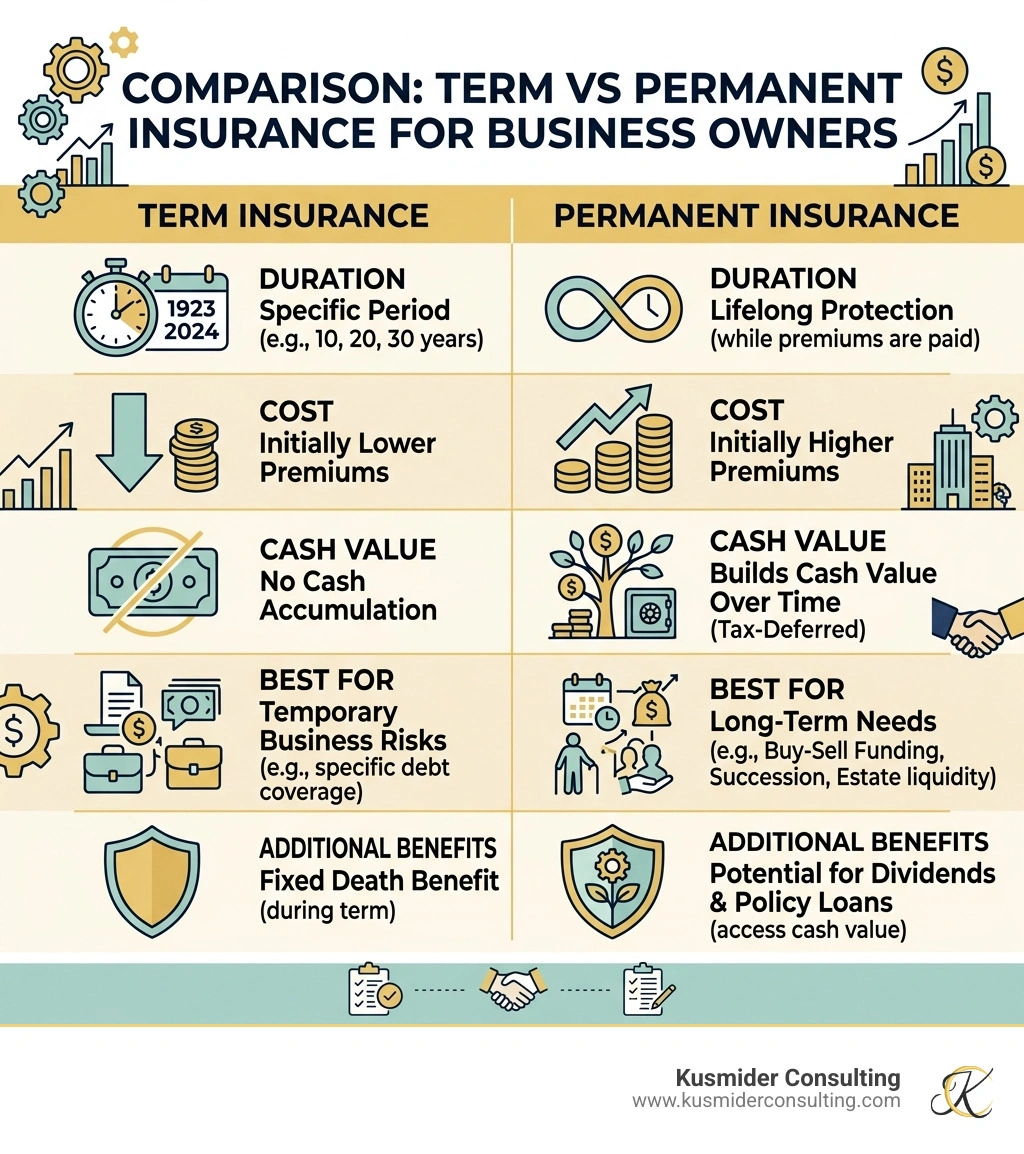
While term insurance is excellent for covering temporary risks like a 10-year business loan, many high-income owners require a more permanent solution. We often focus on Modern Permanent Insurance, such as Whole Life Insurance or Universal Life structures, because they offer lifelong protection and a cash value component.
For the business owner, the cash value in a permanent policy grows on a tax-deferred basis and can serve as a strategic asset. It can be used to fund a partner's retirement, provide emergency liquidity for the business, or act as a tax-advantaged vehicle for wealth transfer. In the context of estate planning, these policies provide the liquid cash needed to pay estate taxes, ensuring that a multi-million dollar business does not have to be liquidated just to pay the IRS.
One of the greatest risks to a business owner's financial security is not death, but a long-term health event. We view Long-Term Care as a financial planning decision, not a health one. If an owner requires care, the cost can quickly drain the business's retained earnings or force an unplanned exit.
We often recommend Standalone Long-Term Care, Hybrid Life, or Life with LTC rider policies. These modern plans ensure that if you need care, the policy helps pay for it. If care is never needed, the death benefit or other policy value remains available based on the design. This is a critical distinction for the high-income professional.
It is important to be direct here: Medicaid spend-down is not a long-term care plan. It is a last resort that requires you to exhaust almost all your assets, sacrificing dignity and choice in the process. True planning involves protecting your autonomy through private funding.
Timing is everything in insurance. We refer to the ages 45-60 period as the "planning window." During this time, business owners and high-income individuals usually have the cash flow to fund robust plans, and more importantly, they often still have the health to qualify for the best options.
The flexibility of a healthy 50-year-old compared to a 64-year-old is significant. At 50, there are often more product choices, more leverage, and more room to tailor coverage around business, estate, and family goals. By 64, underwriting is often tighter, pricing is less favorable, and certain high-leverage products like Hybrid Life with LTC benefits may no longer be available. For clients with a family history of longevity or specific health concerns, acting early is often the best way to preserve flexibility.
At Kusmider Consulting, we do not operate in a vacuum. Elizabeth partners with wealth managers and estate attorneys to provide insurance planning for business owners and high-income individuals age 45 and older. We believe the best business owner life insurance plans are built through collaboration and fit cleanly within the client's legal, financial, and estate planning framework.
For advisors, the role is simple: open the door to the conversation. You do not need to handle product details or policy design. A practical way to start is with phrases like, "We should look at how long-term care planning fits into your broader balance sheet," or "This may be a good time to review whether your business succession plan has the liquidity it needs." From there, Elizabeth can step in to handle the insurance analysis, product evaluation, and planning details. You can find more info for advisors if you are helping clients navigate this planning window.
Our goal is to provide clarity without sales pressure. We aren't here to just sell a policy; we are here to manage a strategy that evolves as your business grows from a startup to a legacy. Whether you are looking to protect a key employee or secure your family's future, we invite you to Contact Us to begin the conversation. You can also learn about our services to see how we tailor coverage for the unique needs of entrepreneurs.
Long-term care is not a distant concern; it is a present planning opportunity. The families who handle it well are the ones who started the conversation early, explored their options with a clear head, and made a decision that fits their life. We are here to help make that process simple, not stressful.
Elizabeth works closely with wealth managers and estate attorneys to bring LTC planning into broader client conversations. To schedule a planning session or discuss a client situation, contact: Elizabeth Kusmider, CFP(r) | Elizabeth@Kusmiderconsulting.com
As a full-service, independent brokerage based in Houston, Texas and available throughout the U.S., we specialize in aligning insurance solutions with broader financial strategies. We provide expert guidance, unbiased product recommendations, and ongoing policy oversight to ensure your coverage evolves with your needs.
Whether you're reviewing your own protection or advising clients, we’re committed to helping you make informed, confident decisions.

Elizabeth founded Kusmider Consulting with a simple goal: help people make informed insurance decisions without confusion or pressure.
As a Certified Financial Planner™, she brings a planning background to insurance work, focusing on how coverage fits into the broader financial picture, not just policy features.
If you’d like to discuss how a topic applies to your personal or professional situation, we’re happy to talk.
Schedule a Planning callLife insurance planning for people who want clarity, structure, and long-term oversight.

Securities offered through Simplicity Investments, Member FINRA/SIPC; 475 Springfield Ave, Summit, NJ 07901 (303) 797-9080. Kusmider Consulting is not affiliated with Simplicity Investments.
The Leaders Group, Inc. Customer Relationship Policy
Broker Check by FINRA .